

TENUTA SANTA MARIA · MDCCXXXV
The 18th-Century Estate and Winery in Valpolicella
Tenuta Santa Maria of the Bertani family — Località Novare, Arbizzano di Negrar, in the heart of Valpolicella Classica
Conceived from the very beginning to produce great, long-aged red wines.
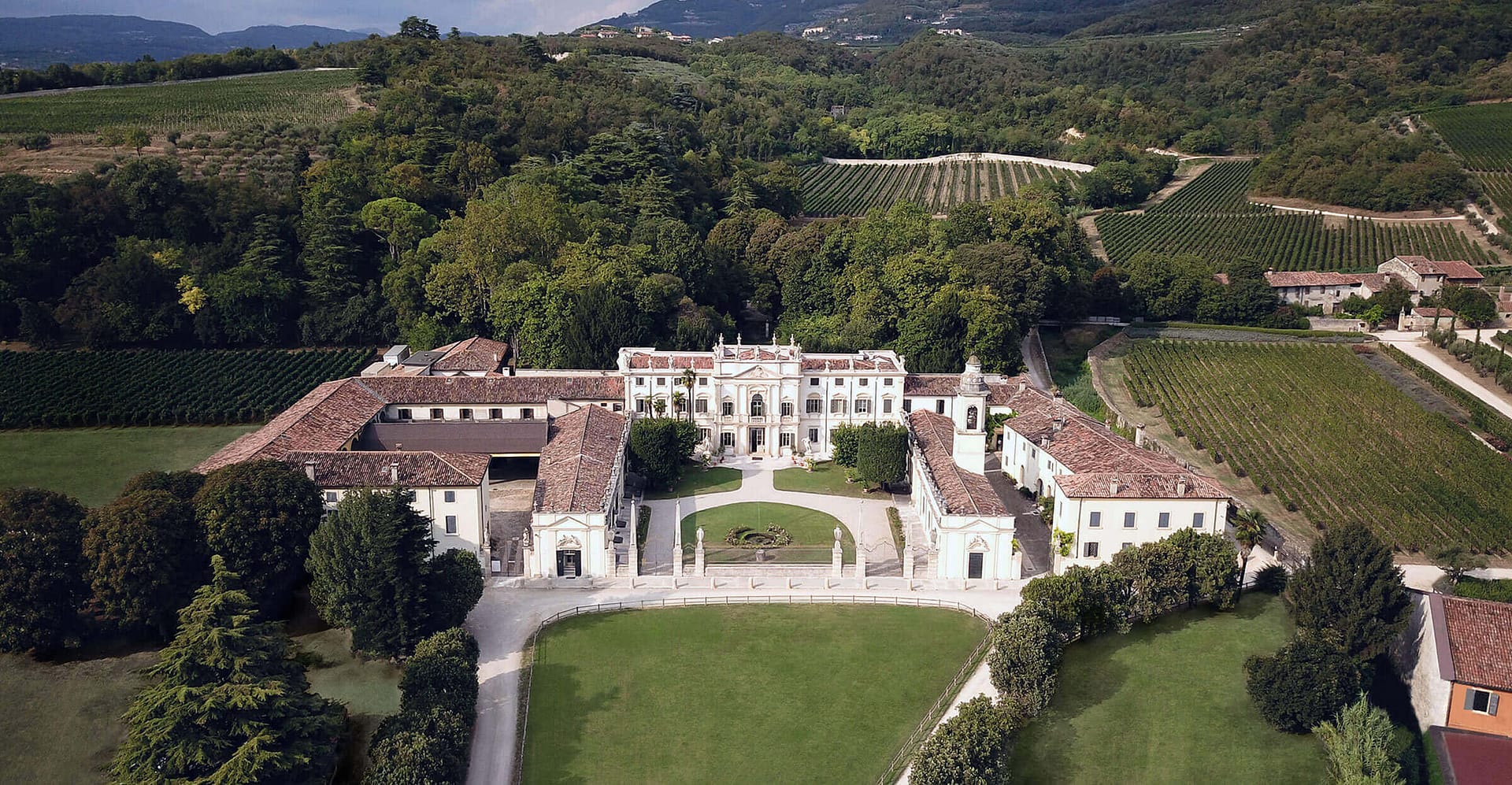
The 18th-century estate and winery is the monumental heart of Tenuta Santa Maria: a place where wine is born not only of the land, but of an idea of civilisation. Residence, winery, walled vineyard, park, chapel, farm courtyard, drying lofts and frescoed halls form a rare whole, in which beauty is never mere ornament but a living part of production.
In the truest tradition of the Venetian villa, the residence and the winery belong to a single design: to inhabit the countryside was to govern it, cultivate it, transform its fruits and receive guests, artists, writers and travellers. To dwell, to farm, to welcome, to produce —all with the same measure.
There is a Valpolicella that cannot be crossed in a hurry. It reveals itself slowly, among the hills of Arbizzano di Negrar, where light settles on the vineyards, limestone holds the memory of centuries, and the air carries the breath of Verona and Lake Garda.
Giovanni and Guglielmo Bertani carry this continuity forward with a contemporary eye: preserving memory, reading each parcel of land, championing the oldest grape varieties of Valpolicella and giving the wines the long time they need in cask.
From this place comes the style that is the signature of the Bertani family’s Valpolicella wines: dry, elegant, of great structure and mineral tension, never opulent. A signature forged over centuries by the walled vineyard, natural appassimento and long ageing in large casks, and handed down through the generations in the pursuit of balance and measure before power.
On this page
A history that begins before the 1700s
Roman springs, a sixteenth-century walled vineyard, the great design of 1735
The Novare valley —where the estate still stands today, in località Novare— holds a memory older than the buildings themselves. The eighteenth-century residence rises on the site of an earlier sixteenth-century cellar —and, before that, of a far more ancient settlement: first of the Arusnates, the pre-Roman people who inhabited these valleys and gave their name to the ancient pagus of Valpolicella, then Roman. Already in that age the valley’s seven perennial springs fed the aqueduct that carried water to Verona, and these ancient waterways speak of a farming vocation that predates the modern age by millennia.
The first documented records of the Bertani family in Valpolicella date to 1567. The original cellar belongs to the same century, as do the earliest maps of the brolo: 22 hectares enclosed by a wall 3.5 kilometres long and four metres high, conceived with striking modernity —on the model of the Burgundian clos— to protect the finest parcels of the valley.
In 1735 the great architectural project took shape, transforming the property into a complete organism: not a residence with a cellar attached, but a monumental wine-growing estate, designed to give order to production and dignity to agricultural life. It is the date the estate still carries in its name: Tenuta Santa Maria 1735.
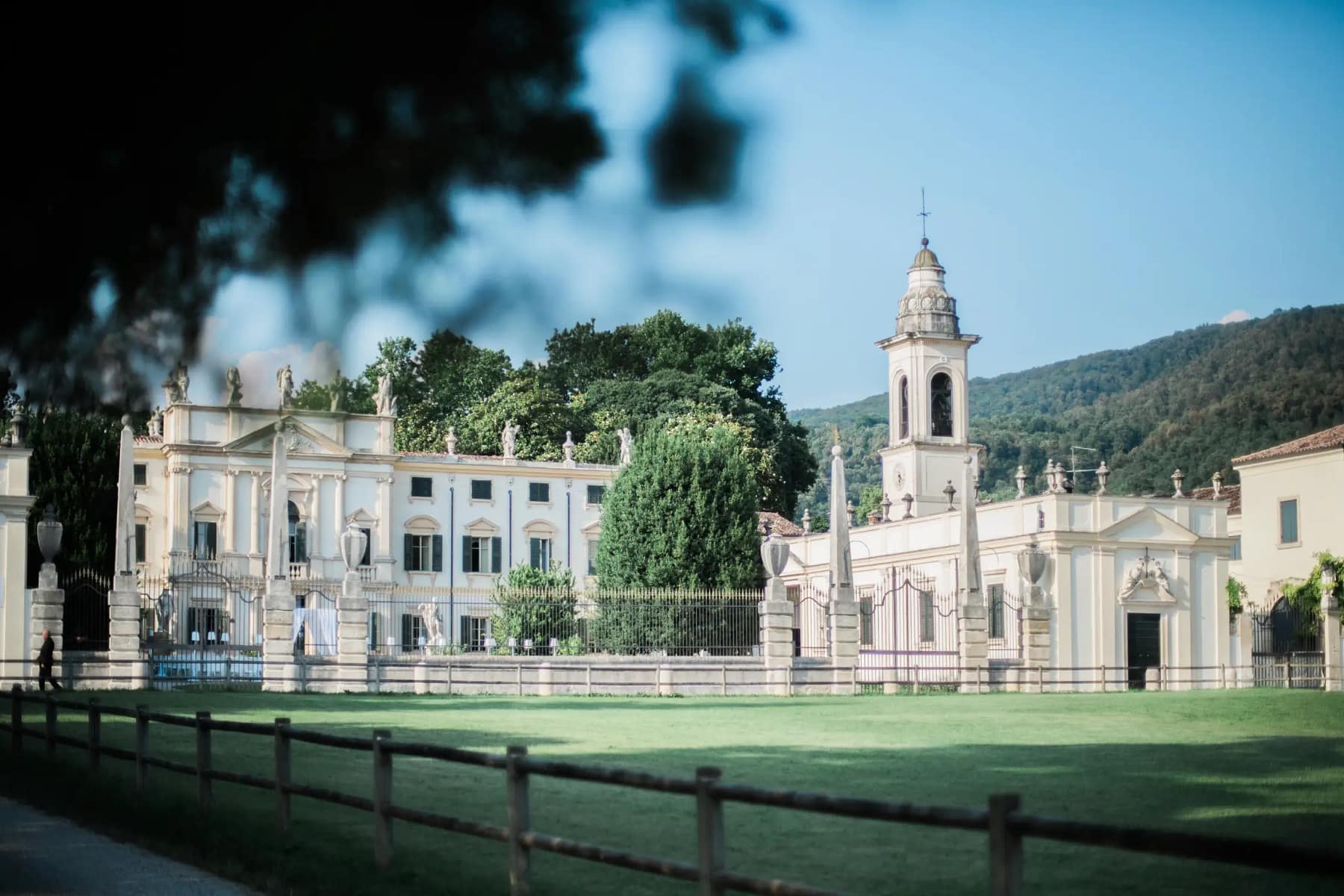
Venetian architecture, winemaking purpose
Representation and labour within a single design
The architecture gracefully interprets the Palladian idea of the Venetian villa: master’s quarters and working farm, representation and labour, contemplation and production, all drawn within a single design.
The eighteenth-century project is linked to the Veronese architect Adriano Cristofali, called to complete and interpret a plan first entrusted to Lodovico Perini. The central body, the side wings, the chapel consecrated to San Gaetano, the farm buildings and the entrances to the cellars compose a scene of neoclassical balance.
The façade rises through two architectural orders —Tuscan on the ground floor, Ionic above— and the tympanum carries mythological figures. Crowning the scene are the statues of the Olympian gods attributed to the Veronese sculptor Lorenzo Muttoni: Zeus, father of the gods, at the centre; at his sides Dionysus —Bacchus, god of wine, recognisable by his barrel— and Hermes, messenger of Olympus; in the front garden, Hercules and Apollo. Above the side entrances stand instead figures in the rural dress of the period: gods above the residence, the countryside above the working doors. One façade, the estate’s whole programme.
Wine is not made beside beauty here: it is part of it. The whole complex reads almost as a neoclassical temple devoted to wine, with the winery at its heart: an architectural, historical and symbolic presence. Every space has a function; every function becomes style.
The Hall of the Muses
The arts, sciences, seasons and the retinue of Bacco
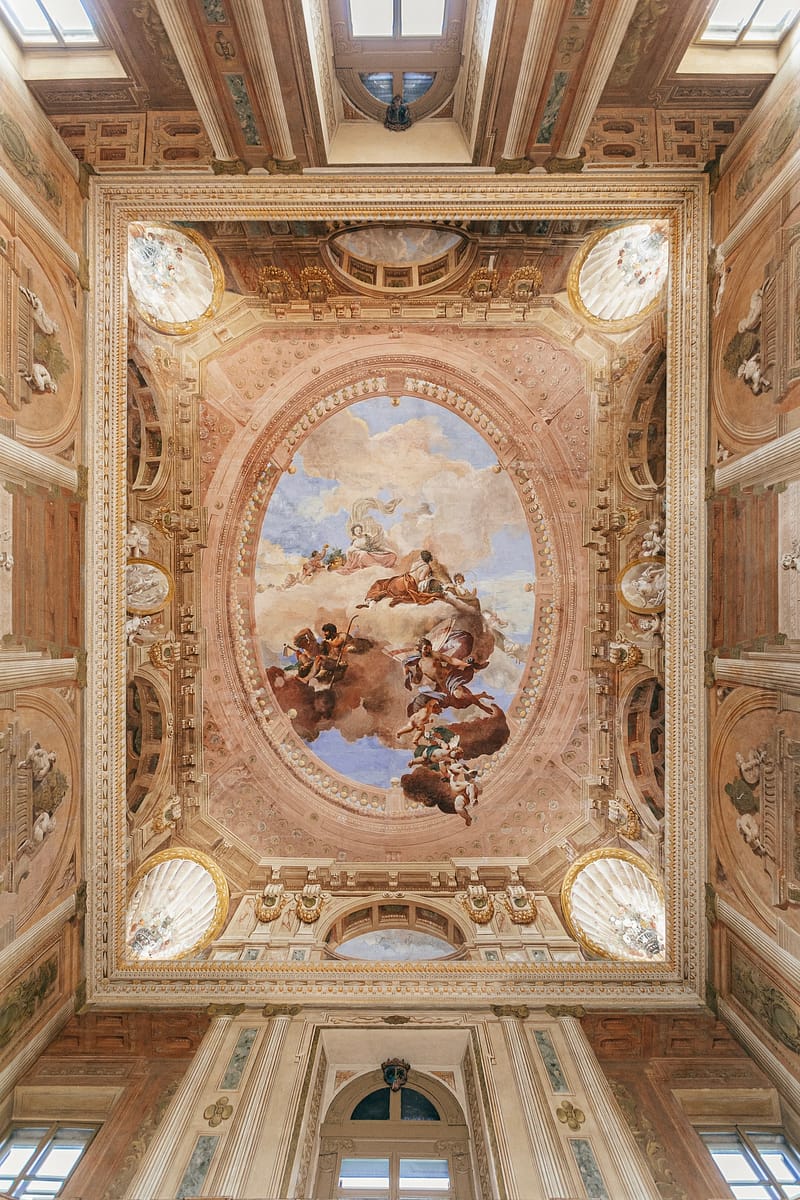
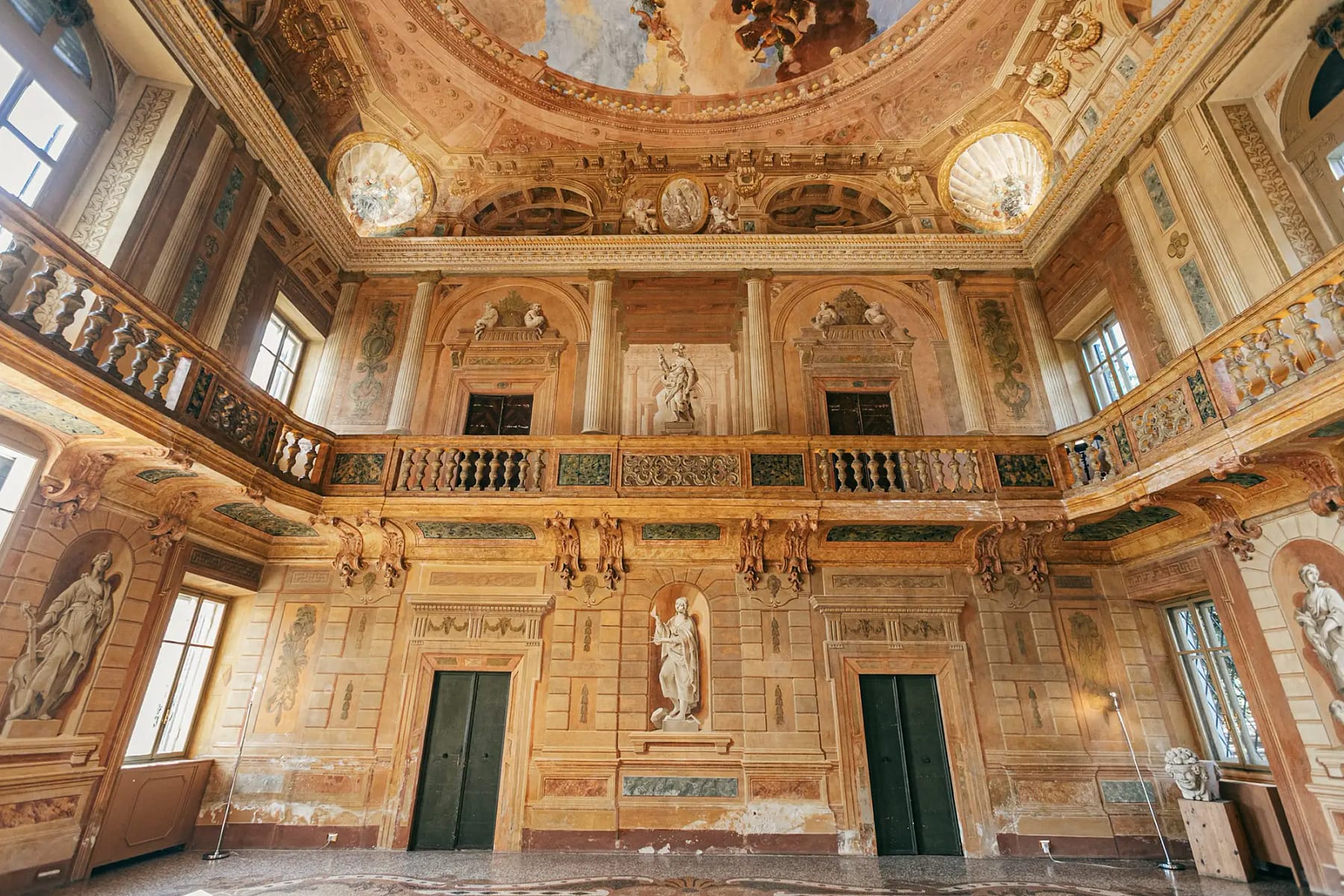
Inside, art becomes narrative. The great Hall of the Muses rises through all three storeys of the residence and turns architecture into theatre: illusionistic perspectives, painted architecture, Muses, allegorical figures, satyrs, seasons, deities and the symbols of the farming year.
The decorative cycle of the two horizontal bands is attributed to the quadratura painter Prospero Pesci, of the school of Filippo Maccari; the central ceiling fresco to Giuseppe Valliani, known as il Pistoiese. At the centre appears Flora, encircled by the four seasons; Zephyr crosses the air and Apollo can be glimpsed on his chariot. Above the upper-floor doors, four satyrs —the retinue of Bacchus— watch over the harvest, as tradition has it: the cycle’s most direct reference to wine, anticipating in fresco the verse Pindemonte would dedicate to these hills. The original Venetian terrazzo floor and the wooden balcony painted as faux marble complete the illusion.
The theme of the seasons is no accident: it is agricultural time made painting. Budding, ripening, harvest, rest, waiting. Before it ever reaches the glass, the wine is already written on these walls — as cycle, as discipline, as promise.
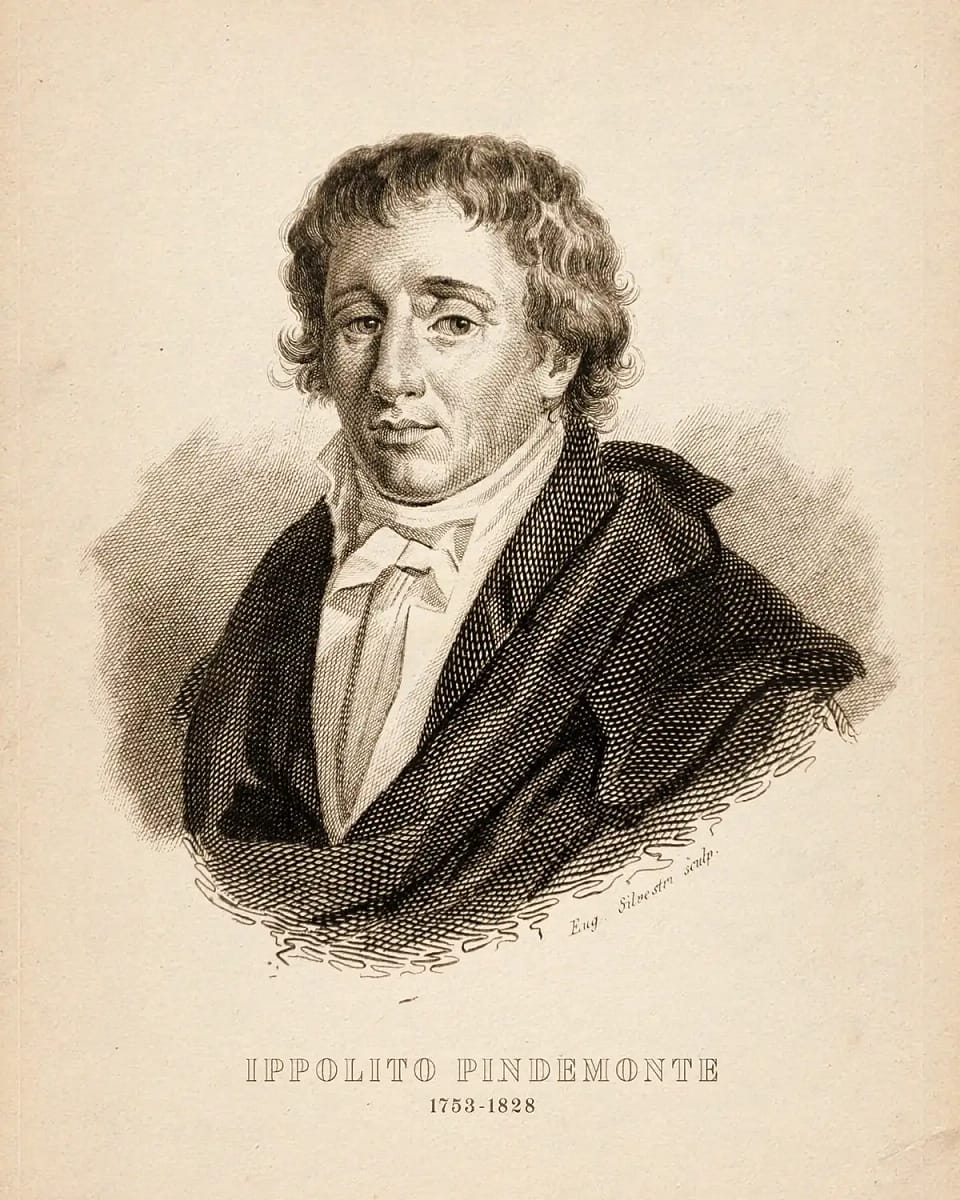
The literary salon of Ippolito Pindemonte
Poetry still inhabits these rooms
Between the late eighteenth and early nineteenth centuries the estate became a place of thought, poetry and conversation. Ippolito Pindemonte —poet, playwright, translator of the The Odyssey and nephew of the scholar Scipione Maffei— stayed here at length, turning these rooms into one of the most celebrated literary salons of the Veneto: a place of European conversation, of reading and music, of gardens, travel and verse.
His classicism was a language the estate already spoke: the Olympian statues, the Muses and Apollo of the frescoes, the invocations of Bacchus and the Naiads belong to the same ancient world Pindemonte inhabited as a translator of Homer. Here the classical ideal of retreat to the countryside —the otium of the ancients, the rural life sung by Virgil and Horace— took built form: a residence in which to think, translate, converse, and watch over the vines.
In Pindemonte, classical order and the new romantic sensibility lived side by side —the estate preserves both: in the formal Italian garden in front of the residence and the English landscape park behind it. Two visions of nature, united by the same sense of proportion.
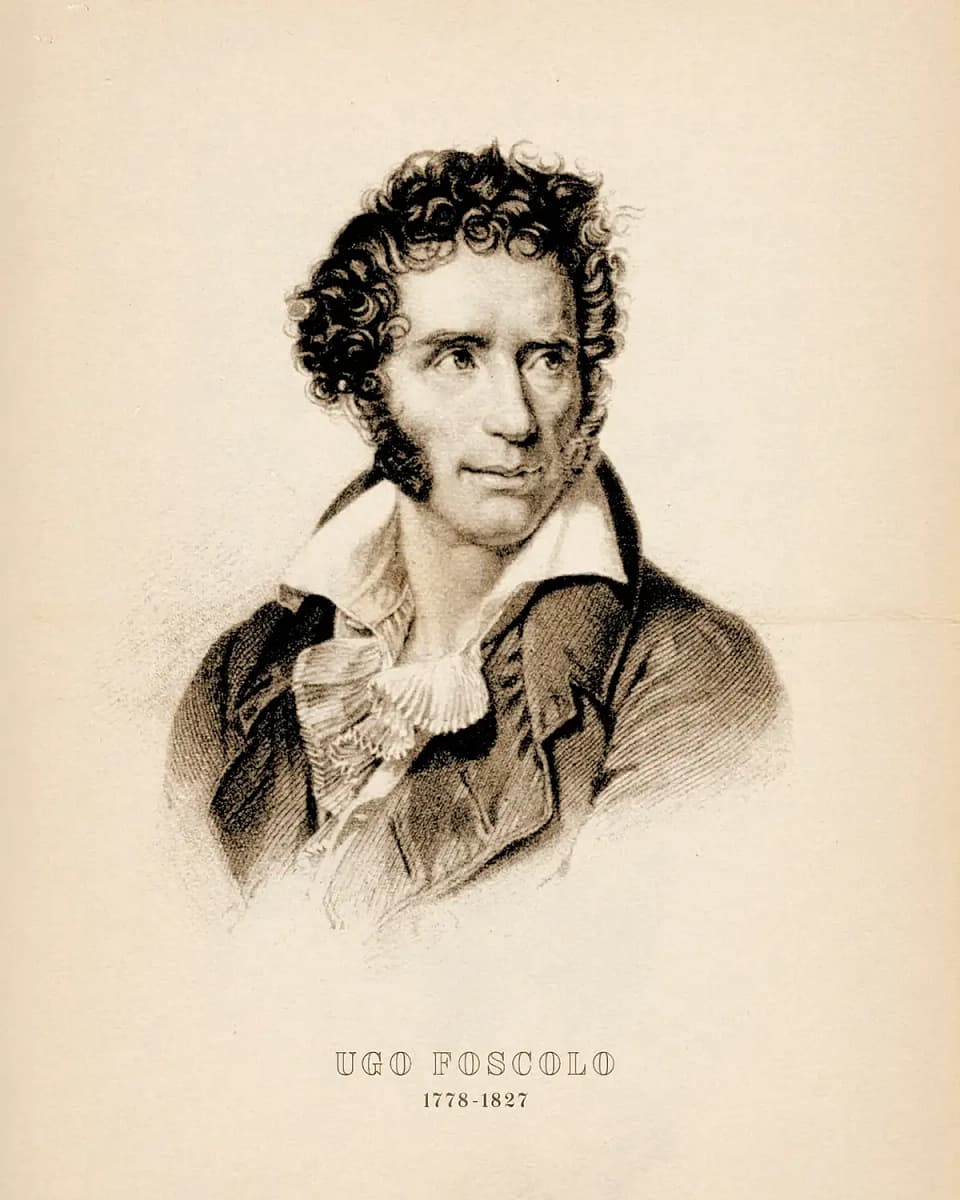
According to tradition, conversations between Pindemonte and Ugo Foscolo at the estate helped inspire Dei Sepolcri, which Foscolo later dedicated to him—linking the estate to one of the major works of Italian literature.
To these wines, Pindemonte dedicated verses that the estate still treasures: “Son cari a Bacco questi colli” — “These hills are dear to Bacchus.” This homage, rooted in Virgil’s Georgics, is the origin of the name given to the heart of the property, the Brolo dei Poeti, and to the park still known as the Poets’ Park.
That cultural dimension lives on in the private and corporate events the estate hosts today: wine meets the written word, music, reading, and the European art of conversation.
A poet’s English-style park
Poetry, art and nature in a single composition
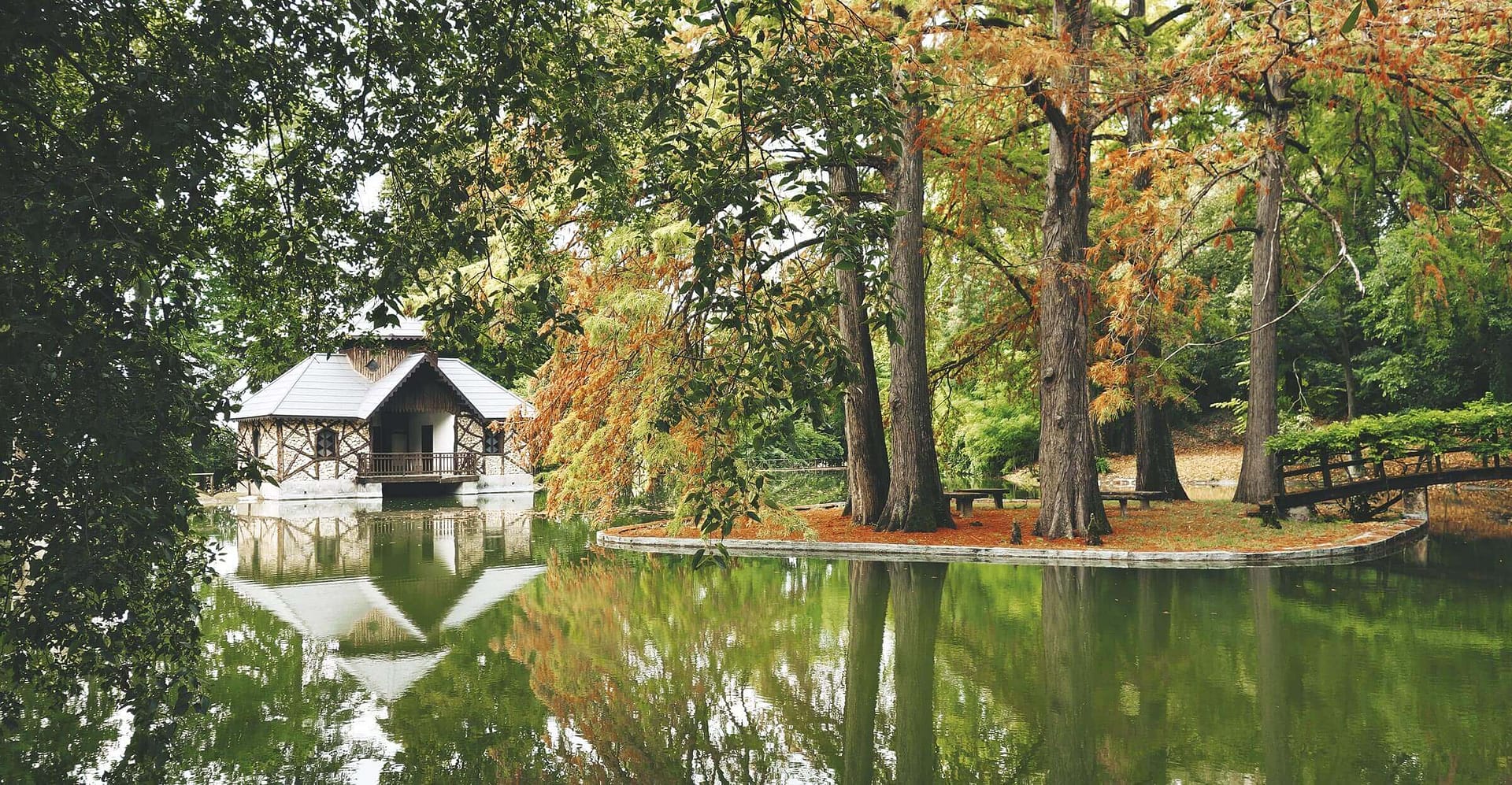
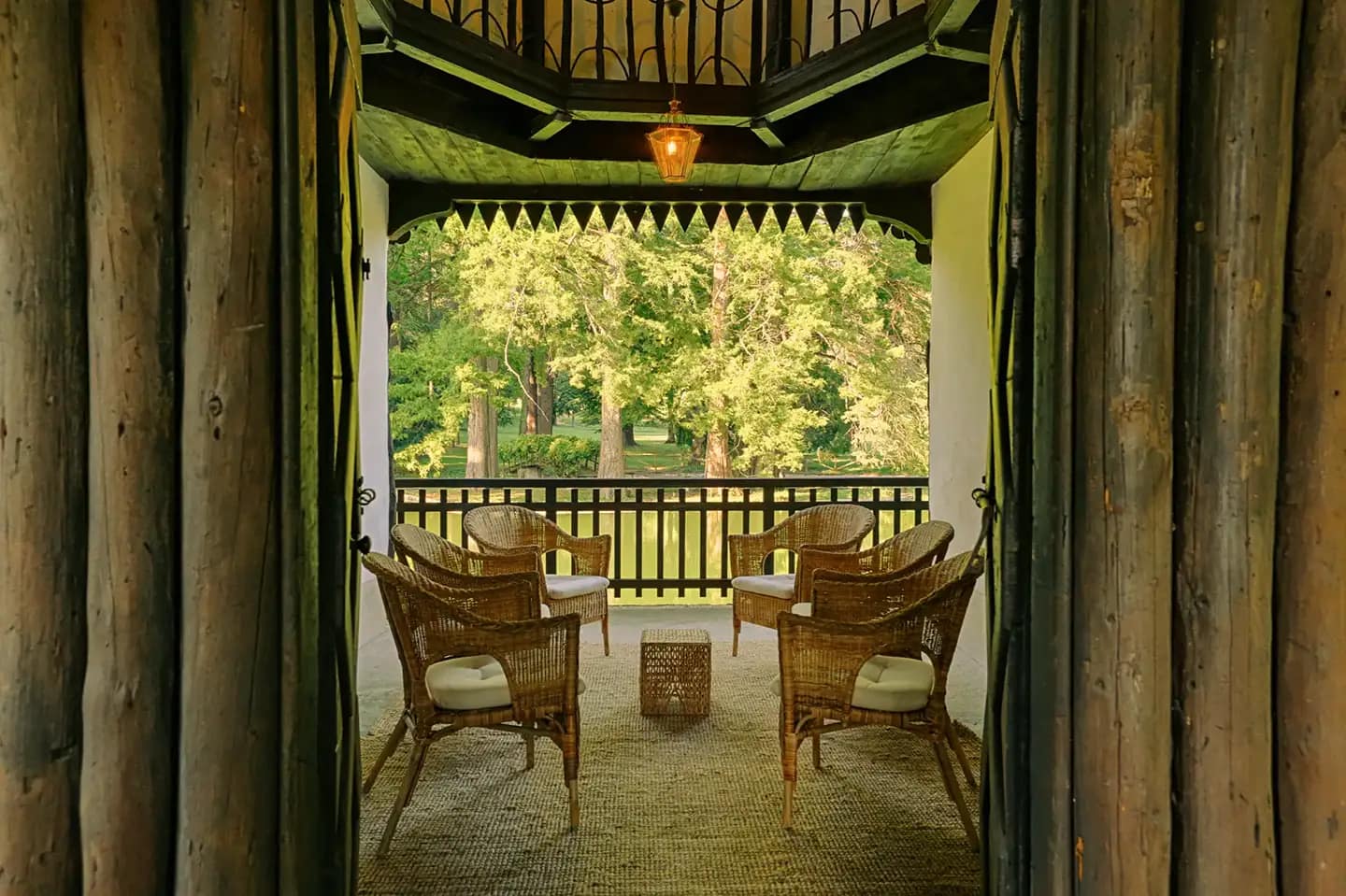
Behind the residence opens a romantic English-style park, conceived not as geometry to be mastered but as landscape to be lived in: shade, paths, water, exotic trees, secluded corners, sudden vistas and light architectural follies compose an intimate, almost literary scene.
The park was suggested by Pindemonte himself, who brought to the estate the free, sentimental taste of the English garden. His ideas converse with his own Dissertation on English Gardens, in which the poet cites Francis Bacon and his vision of the garden as pure pleasure and refreshment of the spirit.
The ornamental lake —shaped after Lake Garda and fed by the estate’s own springs— the small island with its centuries-old bald cypresses from Florida, the cedars of Lebanon, the wooden bridge, the Northern-European coffee house and the chalet recalling Pindemonte’s years in France give the park the character of a green drawing room. By day a place to read and walk; by evening a place to talk, to play music, to let time slow.
In this landscape nature is neither wild nor tamed. It is orchestrated. Like a great wine.
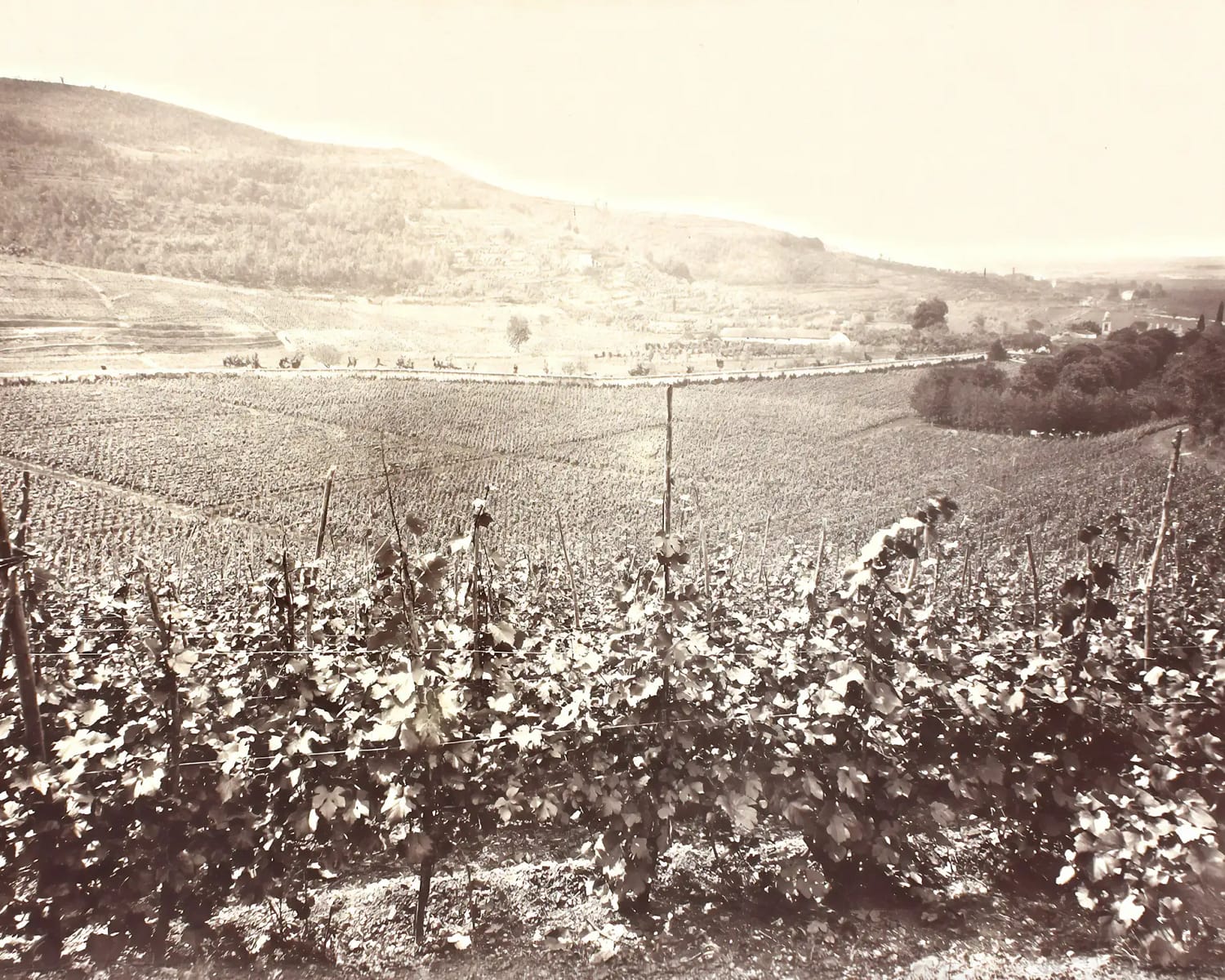
The Brolo dei Poeti, a walled vineyard of Valpolicella Classica
Twenty-two hectares behind a sixteenth-century wall
22
walled hectares
5,600
vines/hectare · Guyot
14
years in the cask, the cru
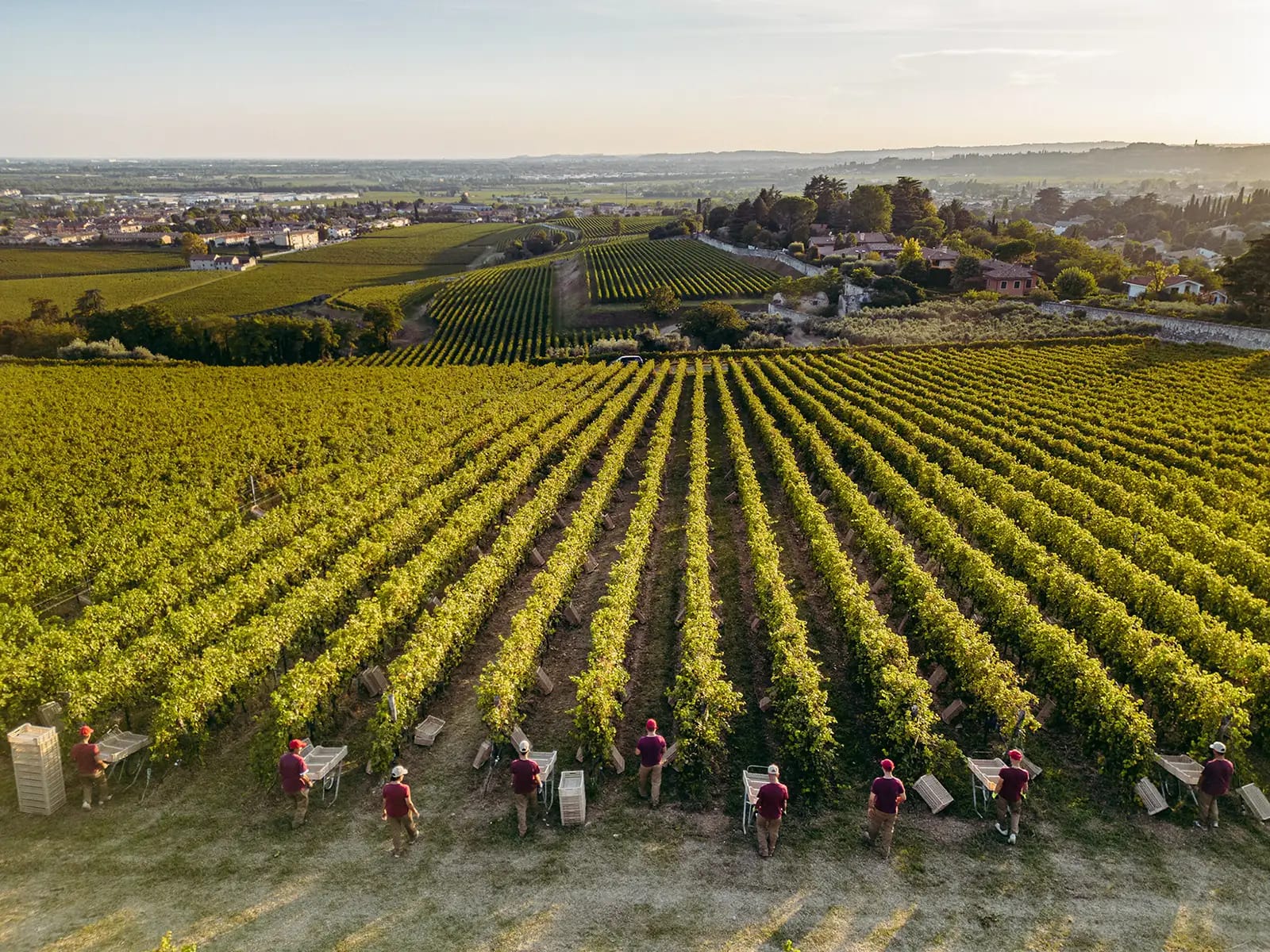
At the agricultural heart of the property lies the Brolo dei Poeti, a historic walled vineyard holding the most precious memory of Valpolicella Classica: 22 hectares protected by the sixteenth-century wall, between 120 and 220 metres above sea level, on marly-limestone soils over a bedrock of calcareous stone.
A brolo is an enclosure of earth, stone and identity, conceived from the outset to produce wines of distinction —selections and crus. It stands among the earliest Italian examples of a vineyard dedicated to single-parcel winemaking —what Burgundy would call a monopole: one walled vineyard, one family— where each plot is not a technical detail but the signature of a place. Its design incorporates the waters of three ancient Roman springs, channelled through hand-carved limestone channels that feed the lake and sustain the vines in the driest seasons. A stretch of woodland, preserved within the wall, recreates in protected form the original ecosystem of Valpolicella.
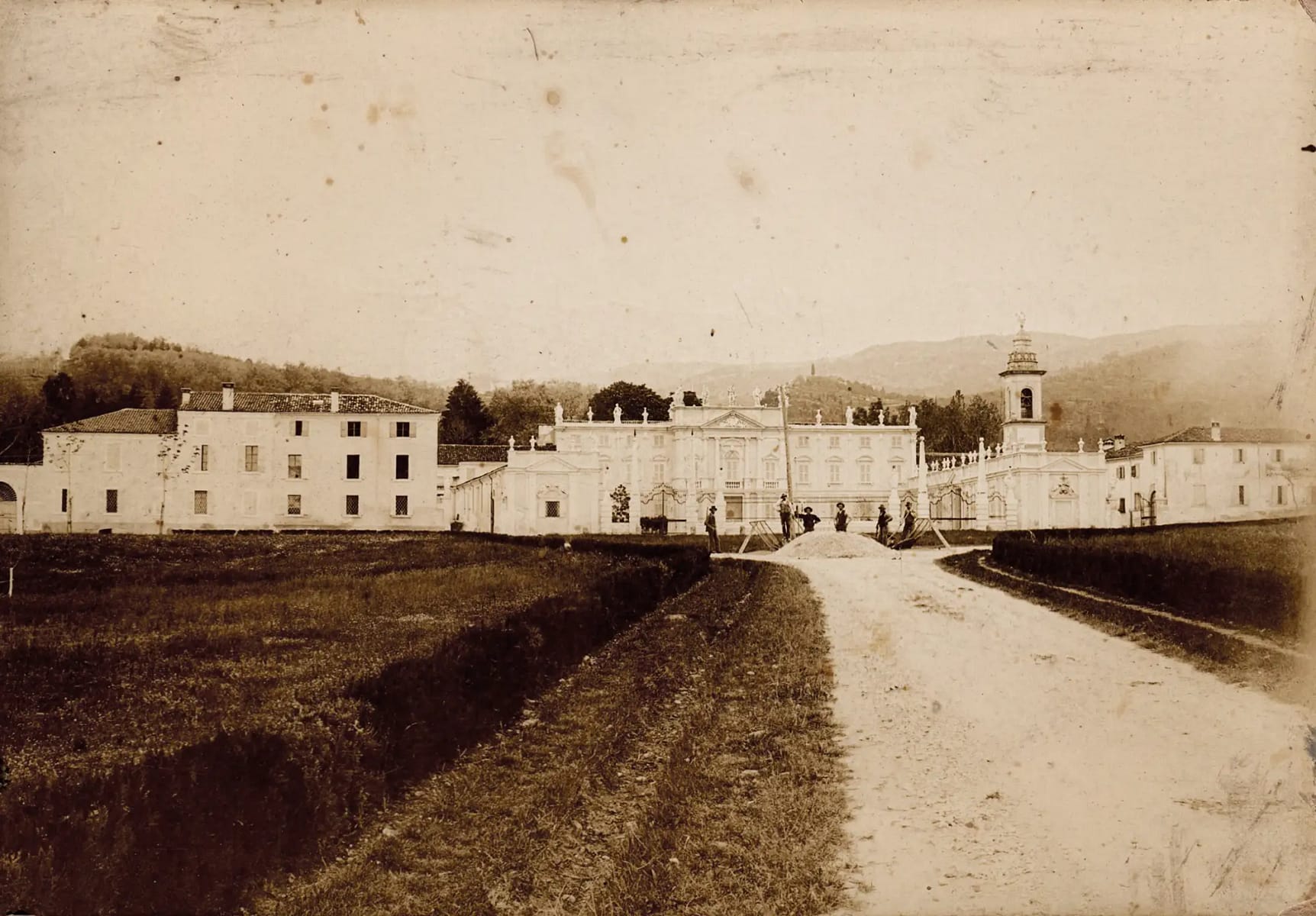
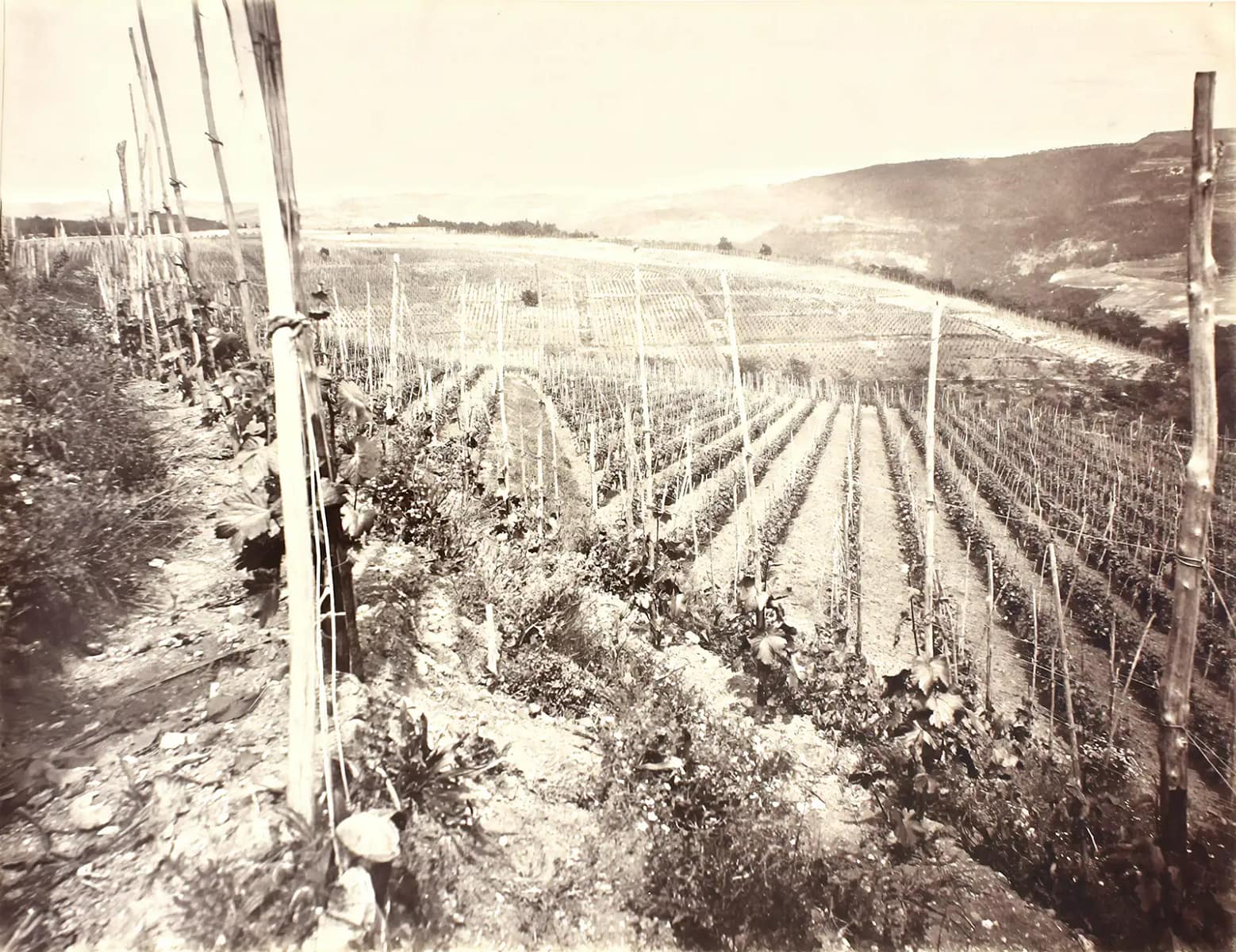
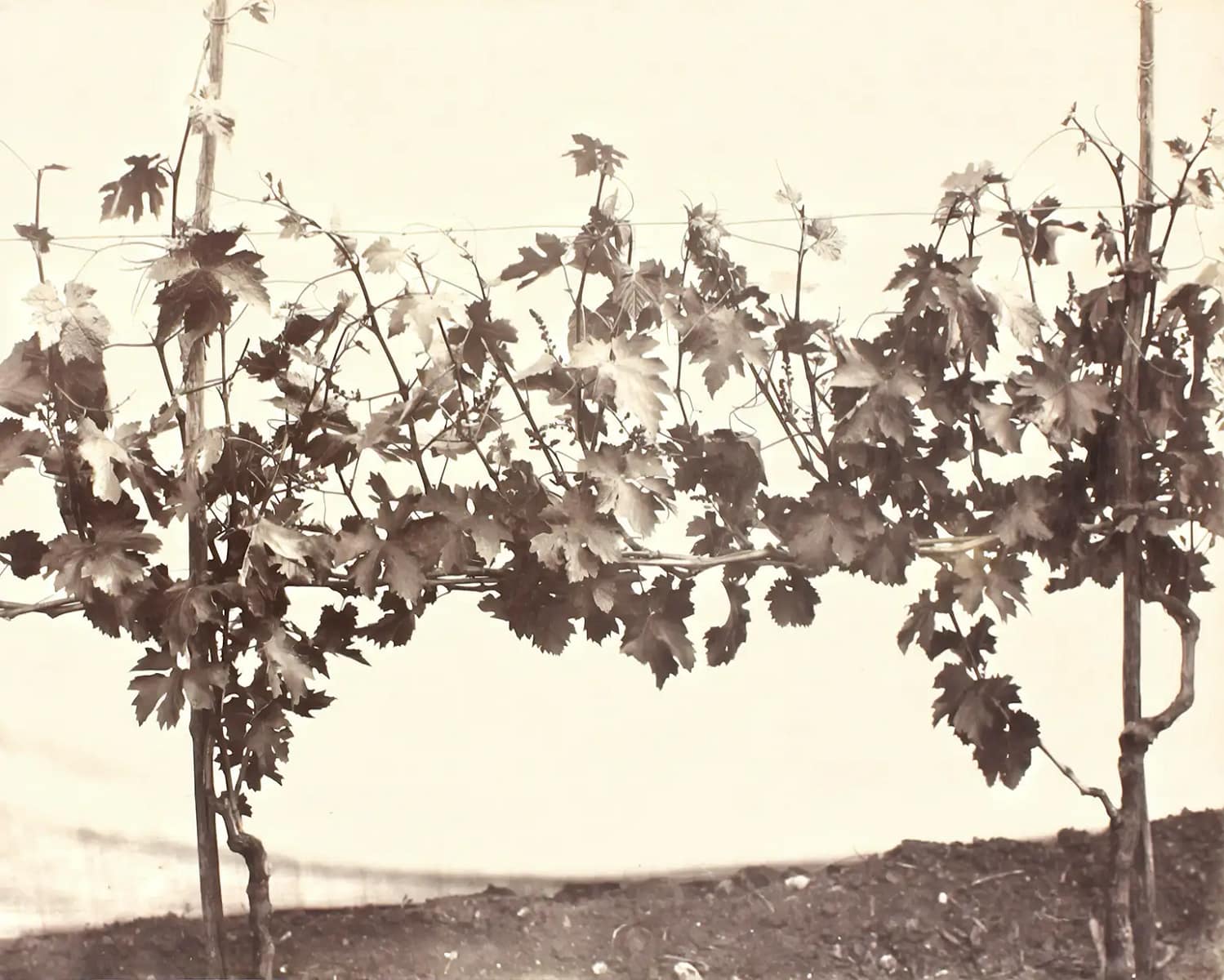
That vocation was confirmed as early as the nineteenth century, when high-density Guyot training was introduced on the estate almost in step with Burgundy and Bordeaux: a remarkably modern choice, witnessed in 1883 photographs by the noted photographer Lotze and documented in an agronomic report of the Verona Academy of Sciences and Agriculture attesting to its historical, cultural and landscape significance. The rows still count some 5,600 vines per hectare, with plants more than 35 years old.
The brolo is divided into parcels at slightly different elevations, each variety planted in close relation to its exposure and to the soil’s variations within the wall. Today these differences are cultivated with precision viticulture and certified sustainable practices: soils, exposures and microclimates read one by one, with separate harvests and vinifications. The nineteenth-century modernity of the Guyot thus continues in a contemporary language.
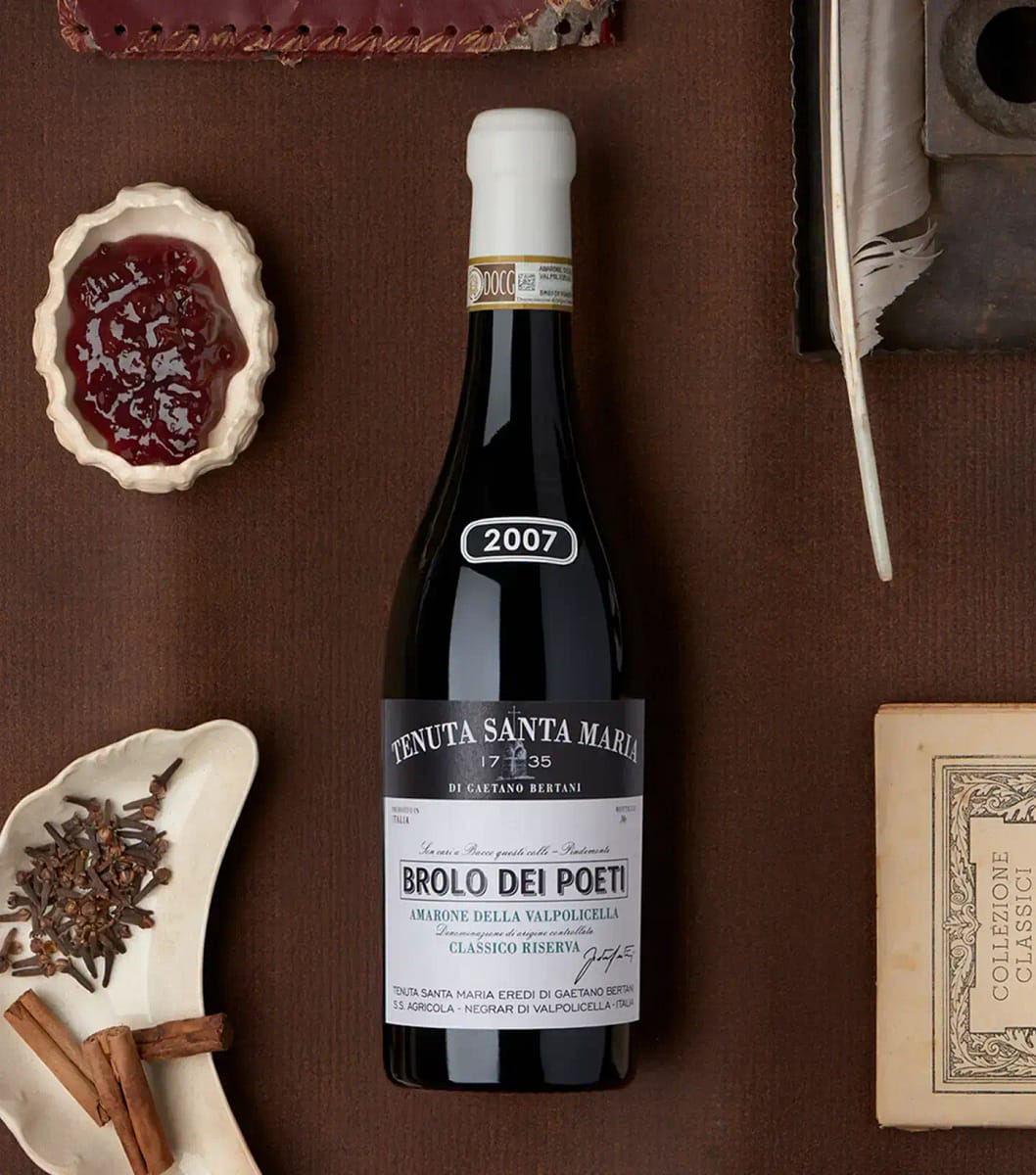
Within the Brolo dei Poeti the estate preserves an old, delicate clone of Corvina found nowhere else, unmistakable in character: naturally low yields, a delicate aromatic profile of strawberry and raspberry, and a graceful acidity that leads to a distinctive elegance. Alongside it grow massal selections of native Veronese varieties such as Oseleta and Rondinella: a genetic and cultural heritage handed down as a living legacy. From the vineyard’s highest parcels, in exceptional vintages only, comes the Amarone Classico Riserva Brolo dei Poeti, the estate’s rarest cru.
The Brolo dei Poeti is more than a vineyard: it is a living archive, a library of roots, a landscape in which every row holds a chapter of Valpolicella’s winemaking history.
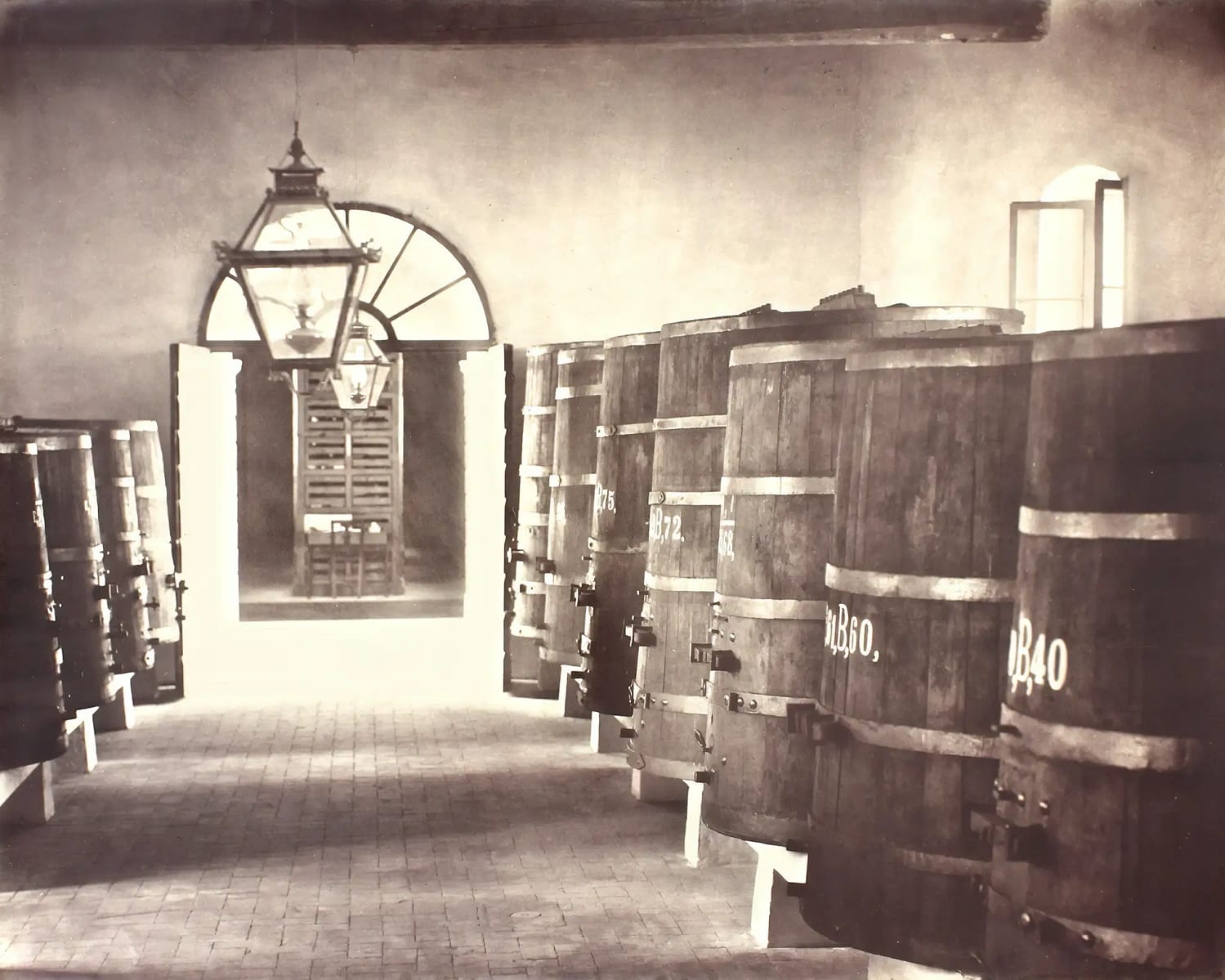
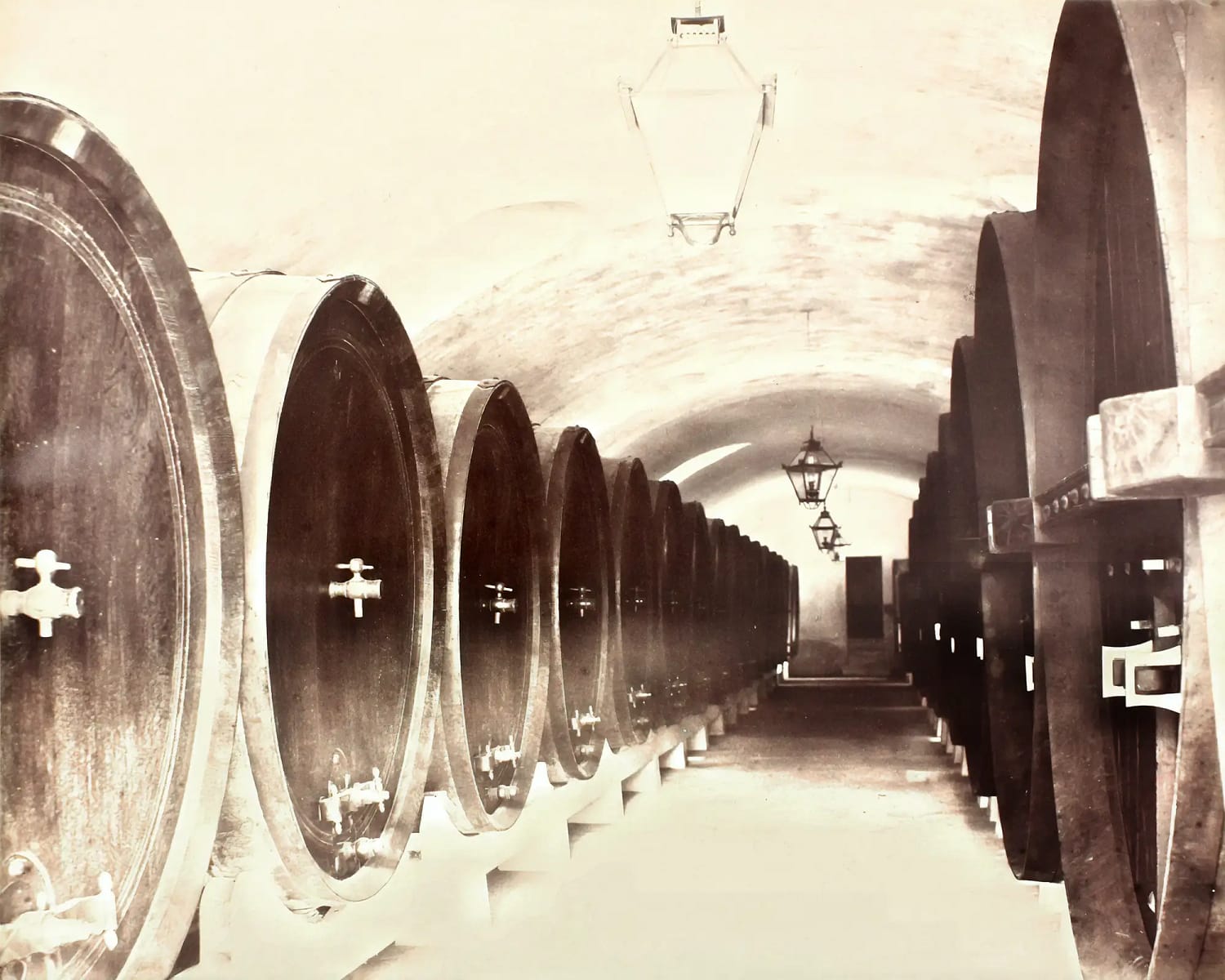
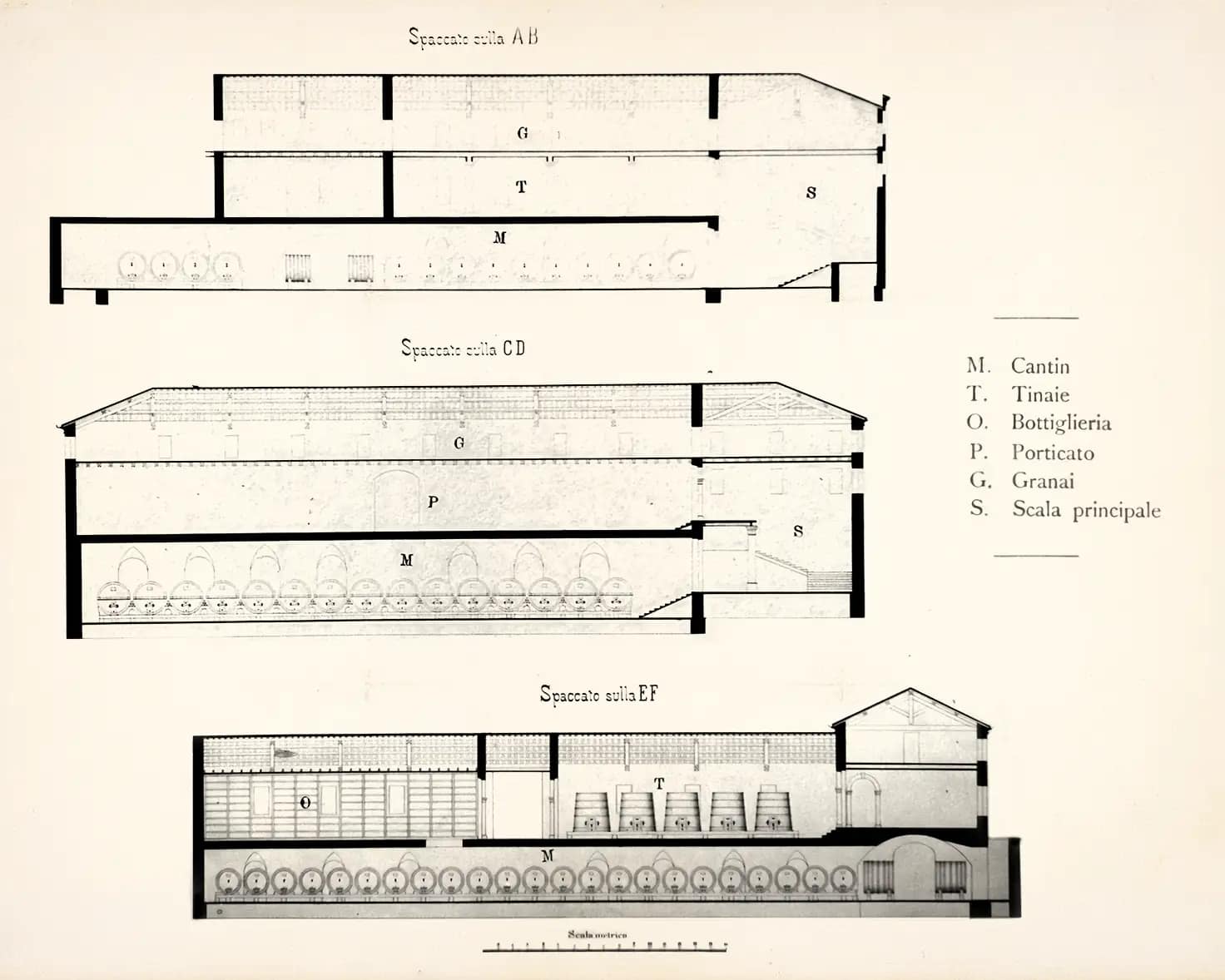
The gravity-flow winery: three levels, one design
From the drying lofts to the monumental cellars
The working winery, which preserves its original sixteenth-century structure, follows a logic that remains current today: a gravity-flow design that accompanies grapes and wine from top to bottom, reducing mechanical intervention and respecting the fruit.
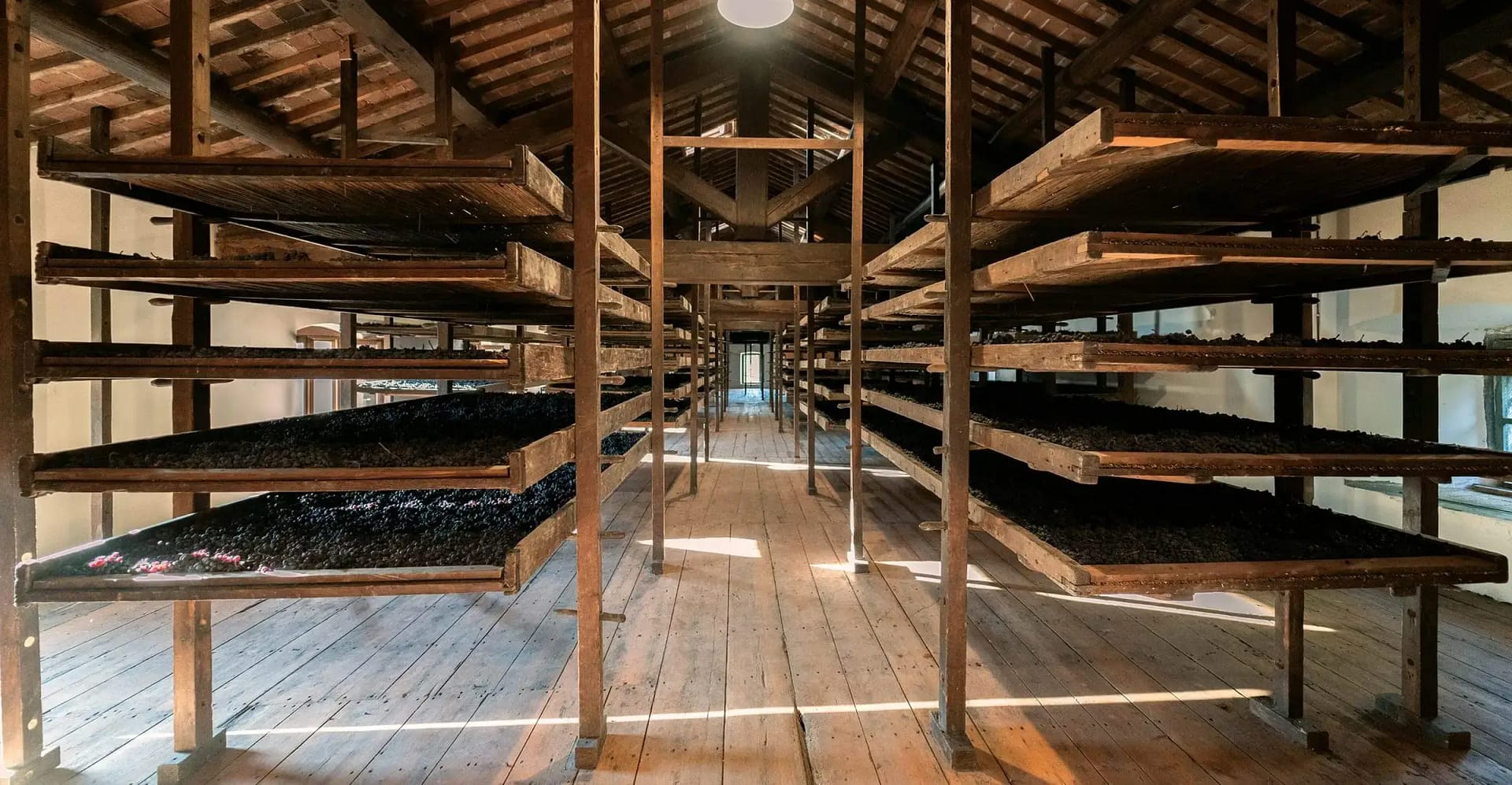
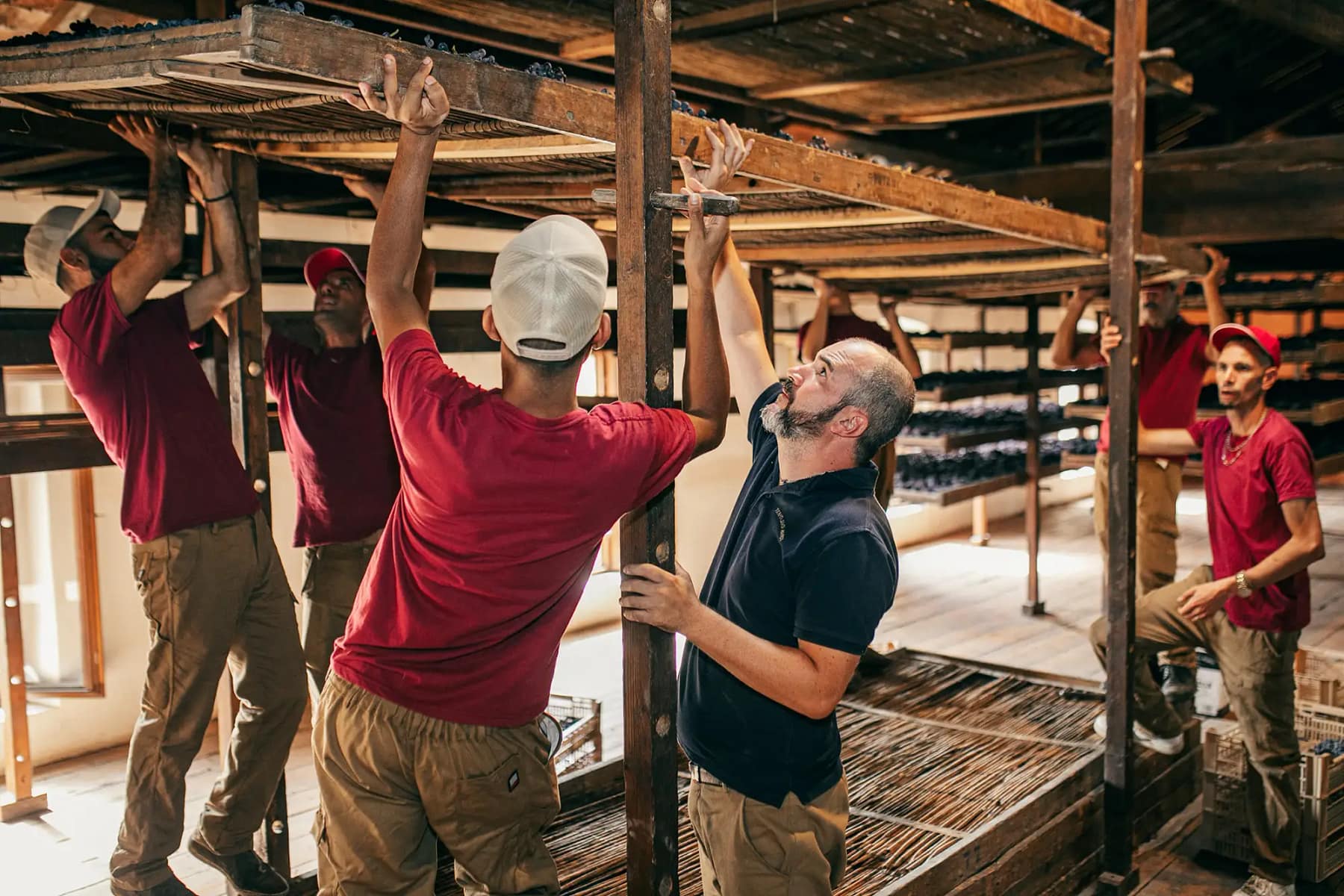
The top floor, opened by tall windows, houses the drying lofts: seven rooms devoted to the natural appassimento of the grapes on bamboo racks called arelle, for around three months, ventilated only by the valley’s own air. It is one of Valpolicella’s most defining rituals, now at the centre of Italy’s national candidacy of “the rite of resting Valpolicella grapes” for UNESCO’s Representative List of Intangible Cultural Heritage.
On the ground floor the wines are made, with separate micro-vinifications for every parcel and variety: steel tanks for temperature- and oxygen-controlled fermentation, and historic concrete vats for the final assemblage before bottling.
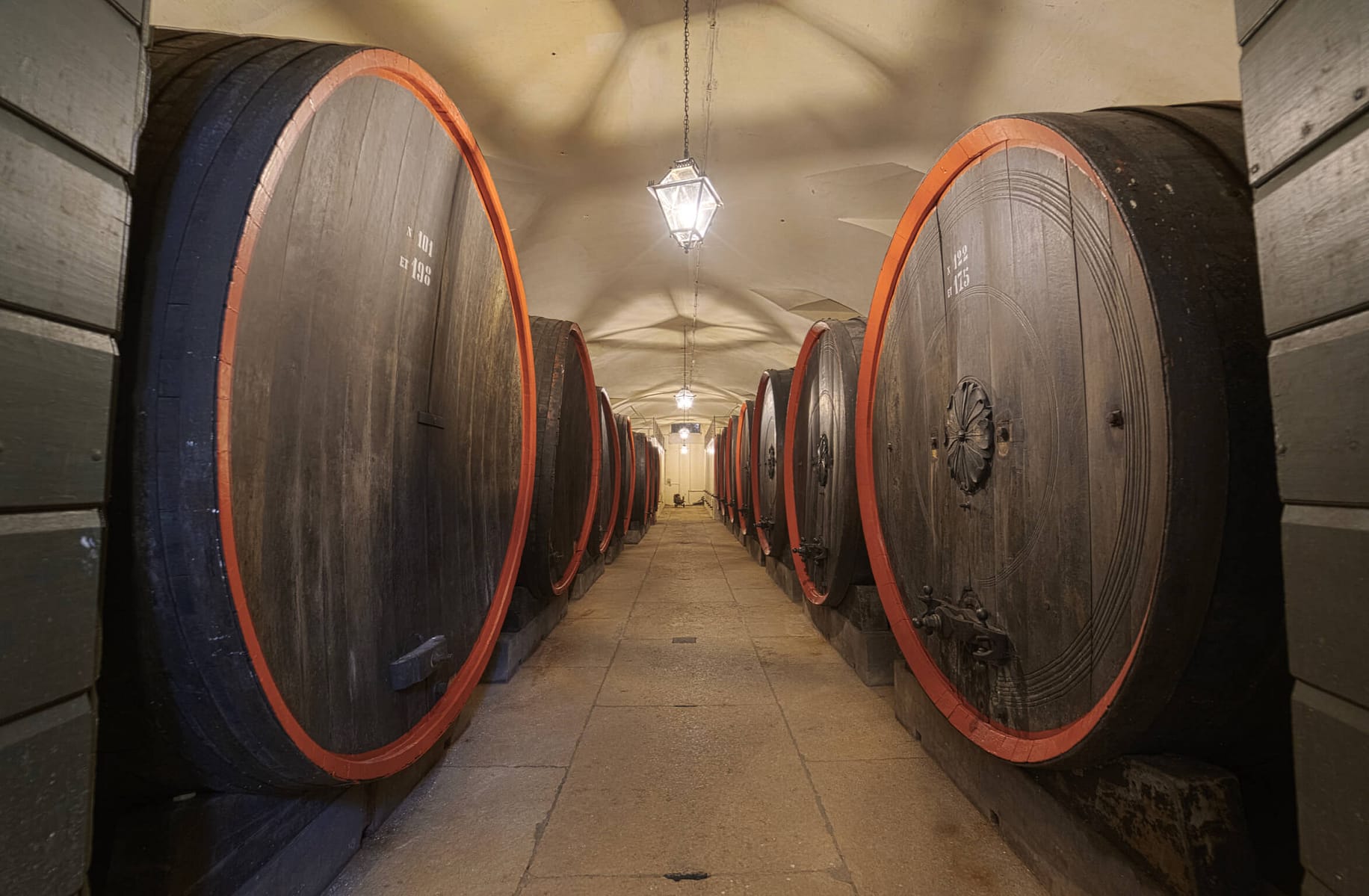
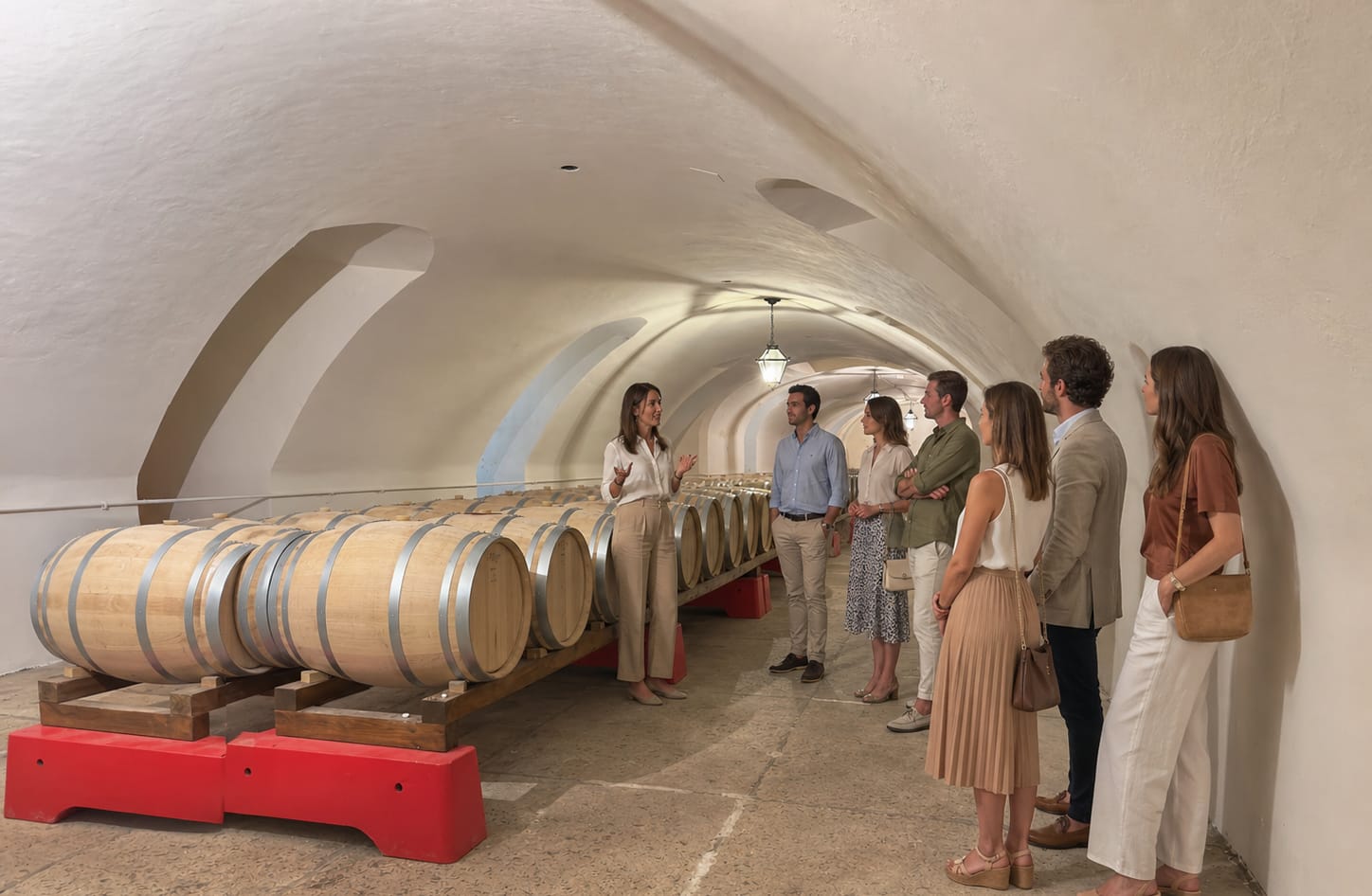
Below lie the monumental cellars, where time becomes matter again: silence, wood, depth, patience. The oldest barrel hall, now a museum space, keeps casks more than two hundred years old —up to 20,000 litres— together with the historic distillery and the old tools of the cellar. The actual vinifications and ageing rely instead on younger Slavonian oak casks, with maturations of up to 14 years for the estate’s cru.
The winemaking history of the estate
The art of patience
The old vinification spaces, the drying lofts and the cellars tell of a culture of production founded on patience: grapes are picked, selected, laid to rest, watched. Wine is born of a farmer’s gesture, but also of a thought —to understand time, and to guide it without forcing it.
Between the nineteenth and twentieth centuries the estate was one of the places that contributed to the birth of modern Veronese winemaking and of Amarone: the early adoption of high-density Guyot training, the lofts for natural appassimento and the long maturations in cask accompanied the evolution of Valpolicella’s great dry reds. Not an isolated episode, but the natural outcome of centuries of experience: grapes, lofts, cellar, intuition.
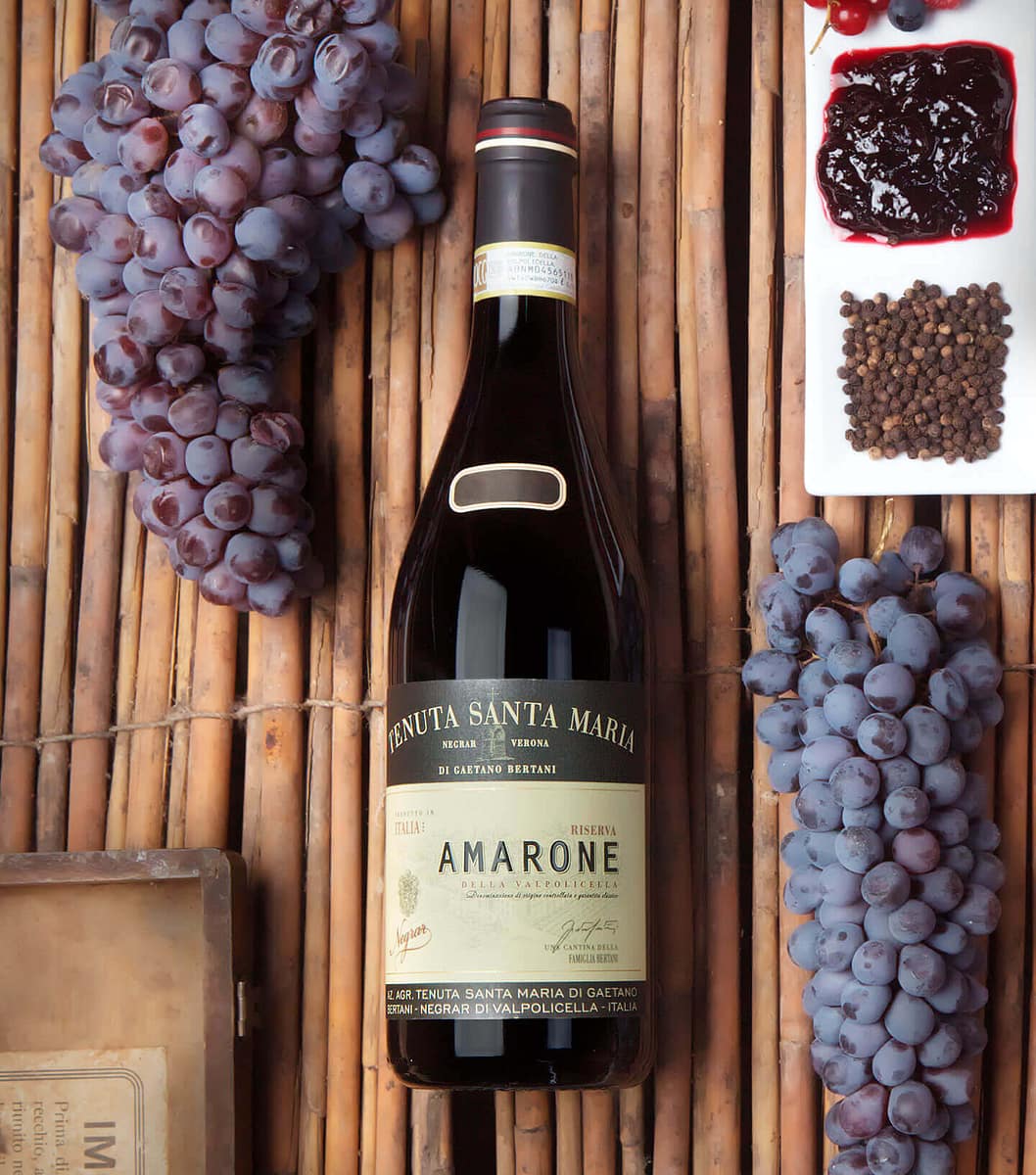
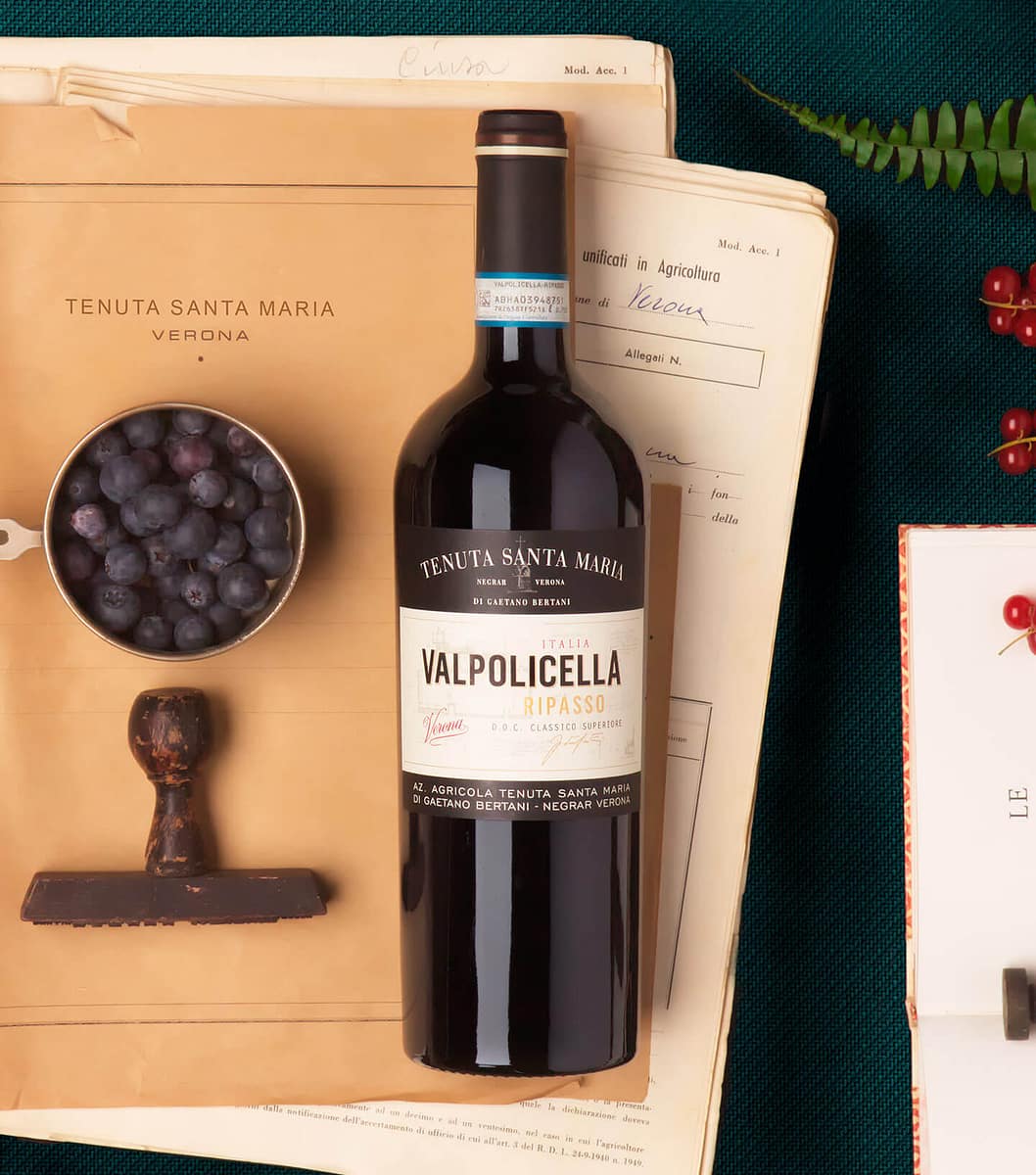
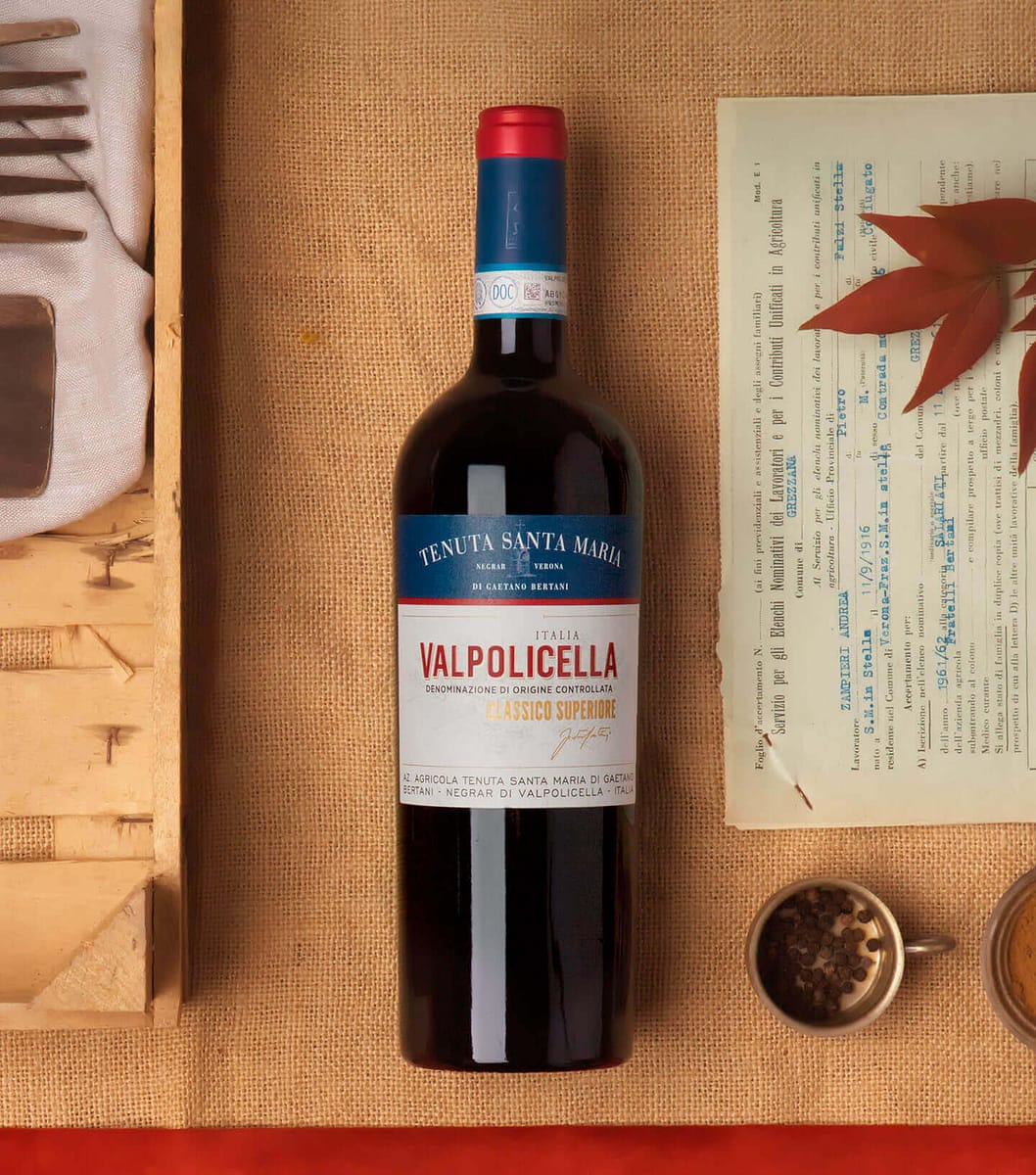
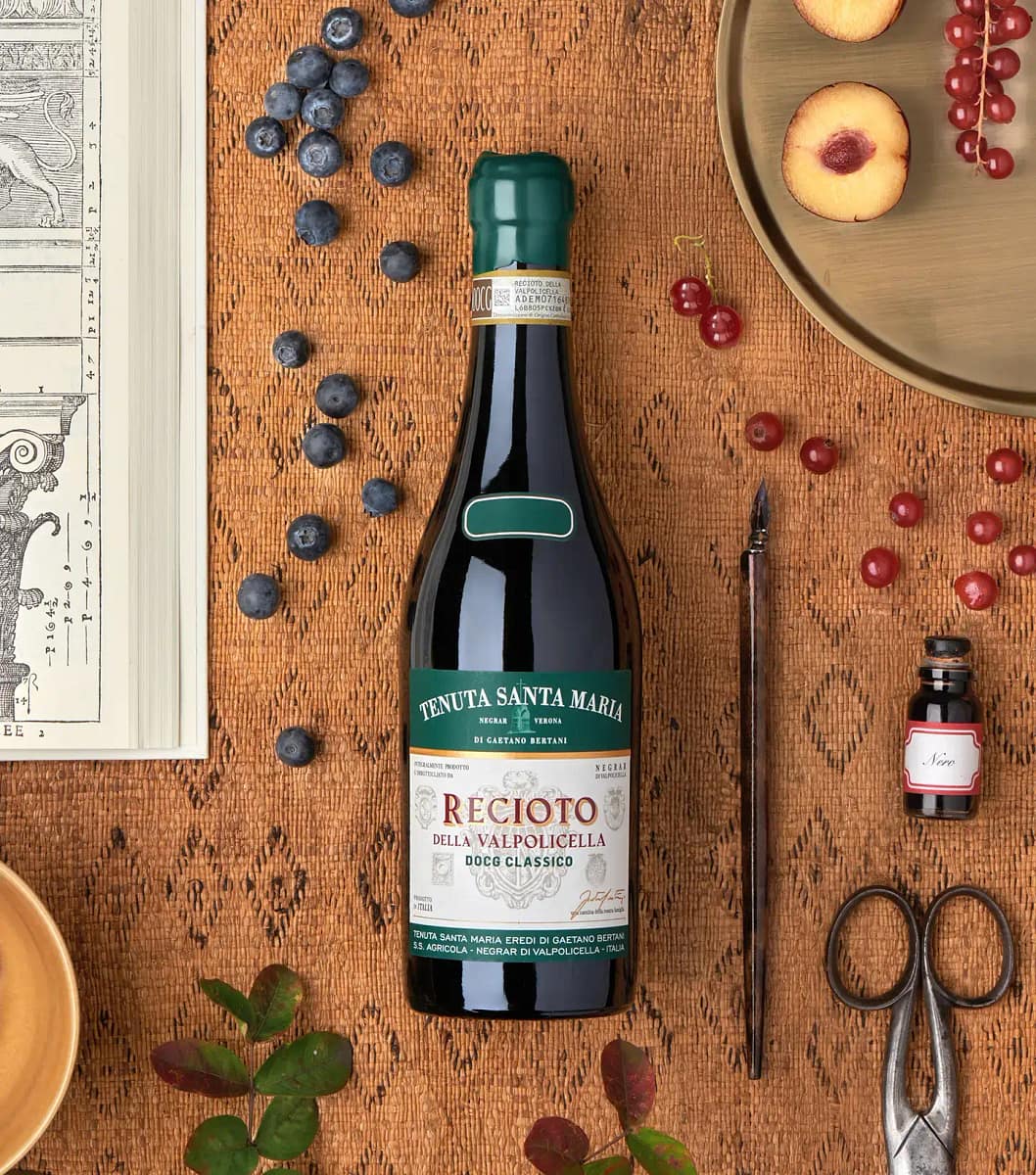
From these same vineyards come today’s expressions of Valpolicella Classica by Tenuta Santa Maria: Amarone, Valpolicella, Ripasso and Recioto.
The estate archive
Five centuries of papers, maps and photographs
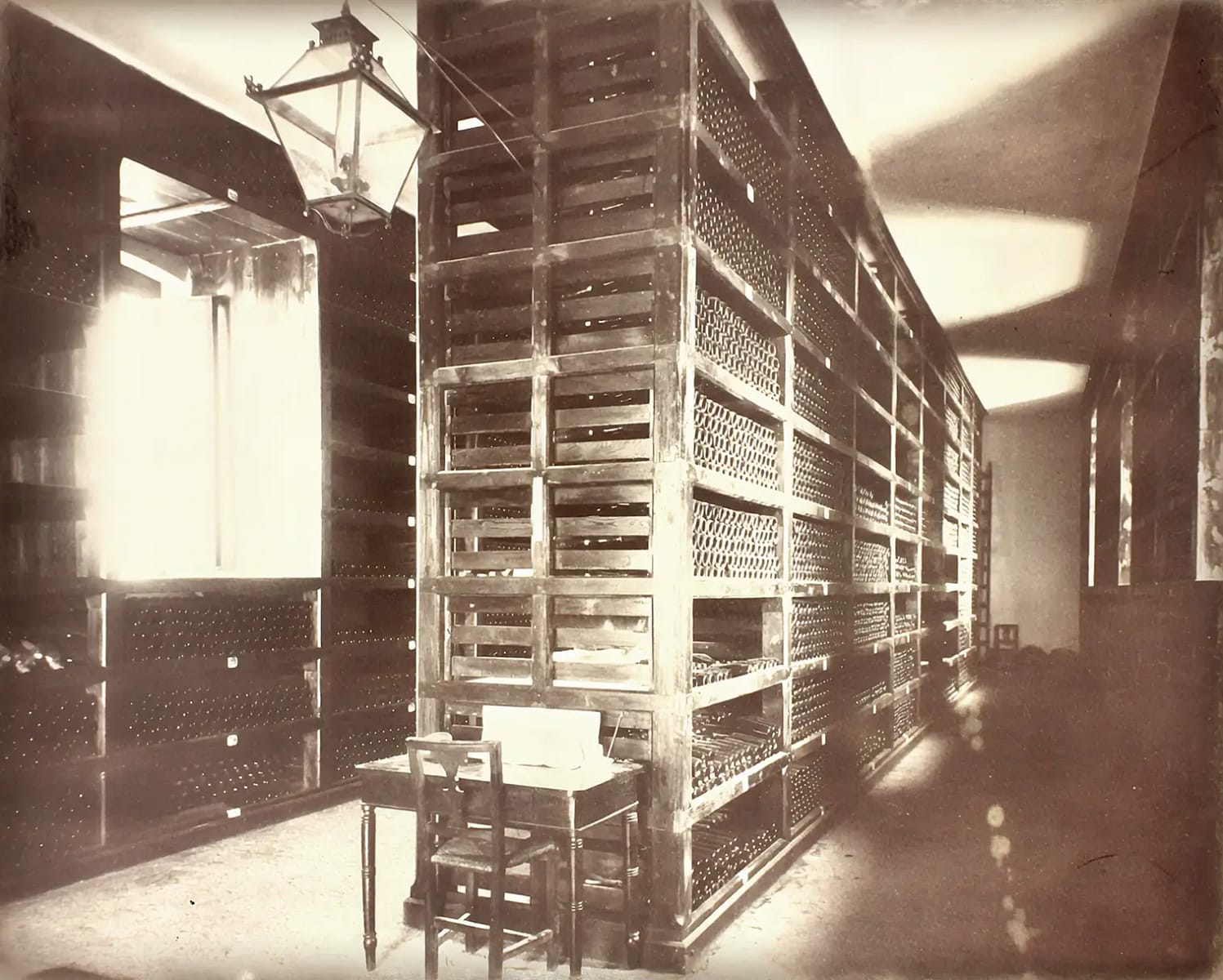
The family’s memory is preserved in original documents spanning five centuries: sixteenth-century tax records attesting the Bertani family’s winegrowing as early as 1567; the earliest maps of the walled vineyard, held in the State Archive of Venice; the nineteenth-century agronomic report of the Verona Academy of Sciences and Agriculture; and the 1883 photographs by the noted photographer Lotze, showing the brolo and its rows already trained to Guyot.
Some of these records accompany the visitor route, including the original 1883 photographs displayed on the winery’s grand staircase.
The style: dry, elegant wines built on time
Our grapes, our method, our signature
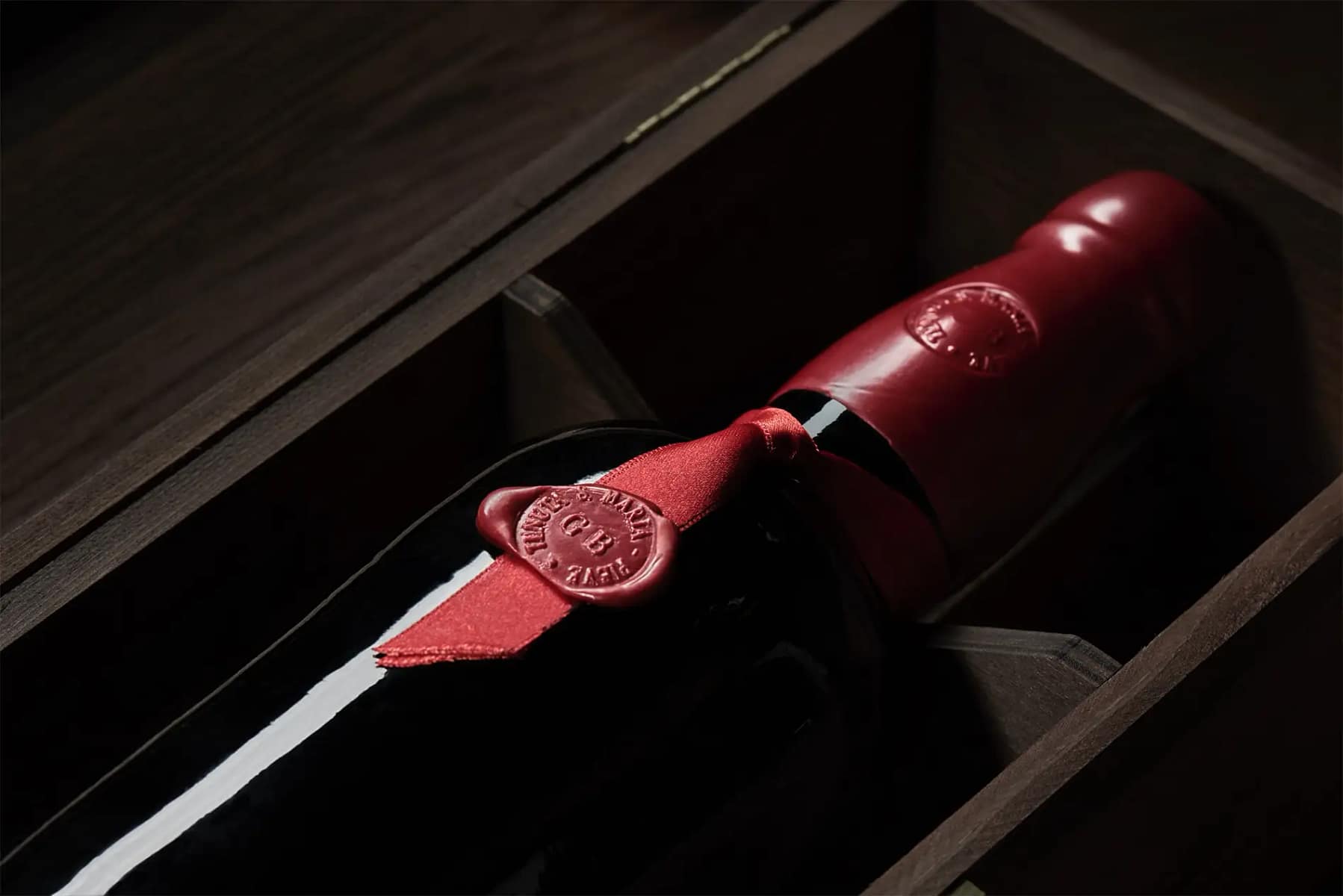
The estate’s wines come exclusively from its own vineyards and answer to a precise idea: elegance, freshness and depth —never opulence. A slightly earlier harvest preserves the grapes’ natural acidity; appassimento, carried out entirely naturally on bamboo racks —today unique in Valpolicella— builds complexity without sliding into over-ripeness; parcel-by-parcel micro-vinifications and long maturations in large Slavonian oak casks let the vineyard speak, not the wood.
The result is an unmistakable style —the family’s signature: dry wines of great structure and a natural gift for ageing, which stay taut, precise and gastronomic, threaded with the mineral tension of limestone soils. An Amarone that can be a wine of meditation without ever leaving the table: where others pursue power, this house pursues balance and measure.
Visits and tastings
Valpolicella at its most graceful and secluded
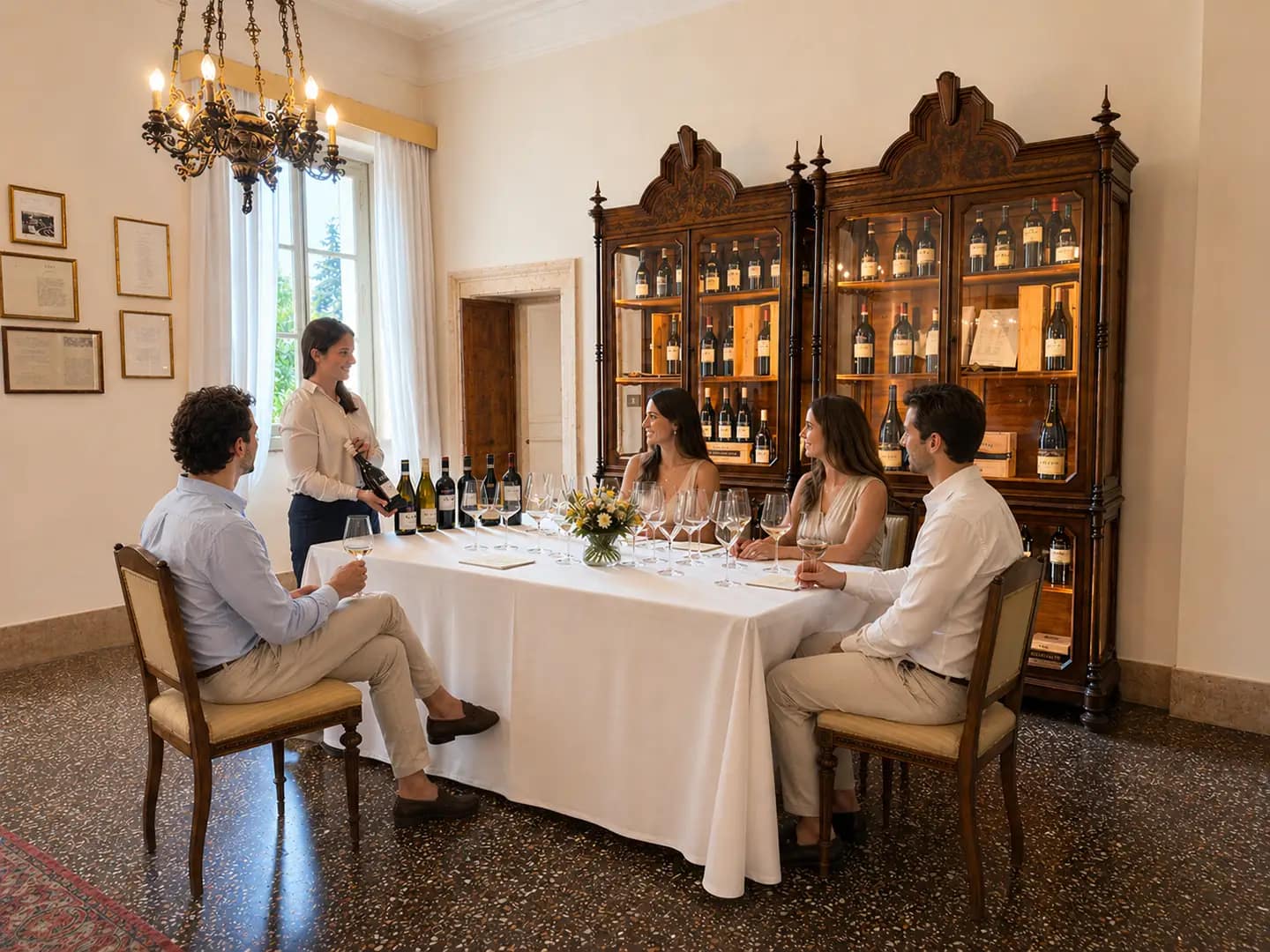
A tour of the estate is a journey through Valpolicella at its most graceful and secluded: the eighteenth-century architecture, the Hall of the Muses, the romantic park suggested by Pindemonte, the Brolo dei Poeti, the drying lofts, the winemaking spaces and the monumental cellars devoted to long ageing.
Each season shows a different face: the September harvest, the drying lofts filled with resting grapes in autumn, the winter silence of the barrel halls, the walled vineyard and the park in spring light. The estate is open all year round, closing only on major holidays.
A guided tasting closes the tour like a return to the source: landscape becomes wine, history becomes taste, memory becomes experience.
Time, here, is an ingredient. For five centuries — and still today.
— Giovanni and Guglielmo Bertani
Where we are
Ten minutes from Verona, twenty kilometres from Lake Garda
The estate lies in località Novare, Arbizzano di Negrar, in the heart of Valpolicella Classica, minutes from Verona and some twenty kilometres from Lake Garda, on the axis linking Milan to Venice. A sheltered, luminous valley: a place where the vine finds balance, wine finds depth, and hospitality recovers its truest meaning. To learn more about the region’s soils and climate: The Terroir and climate of Valpolicella.
Frequently asked questions
Amarone, Valpolicella and the estate
About Amarone
About Valpolicella
About the estate, tours and tastings
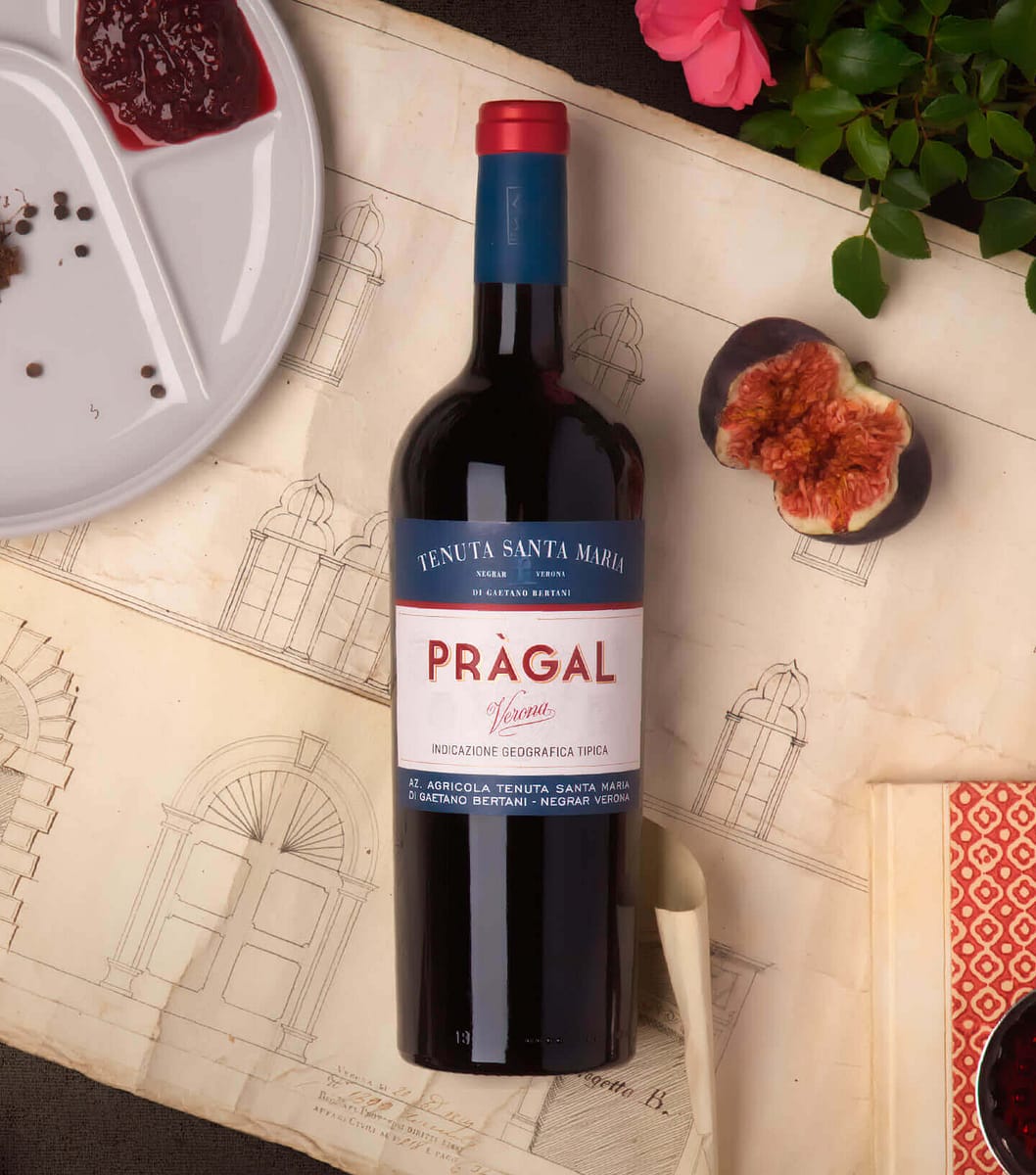
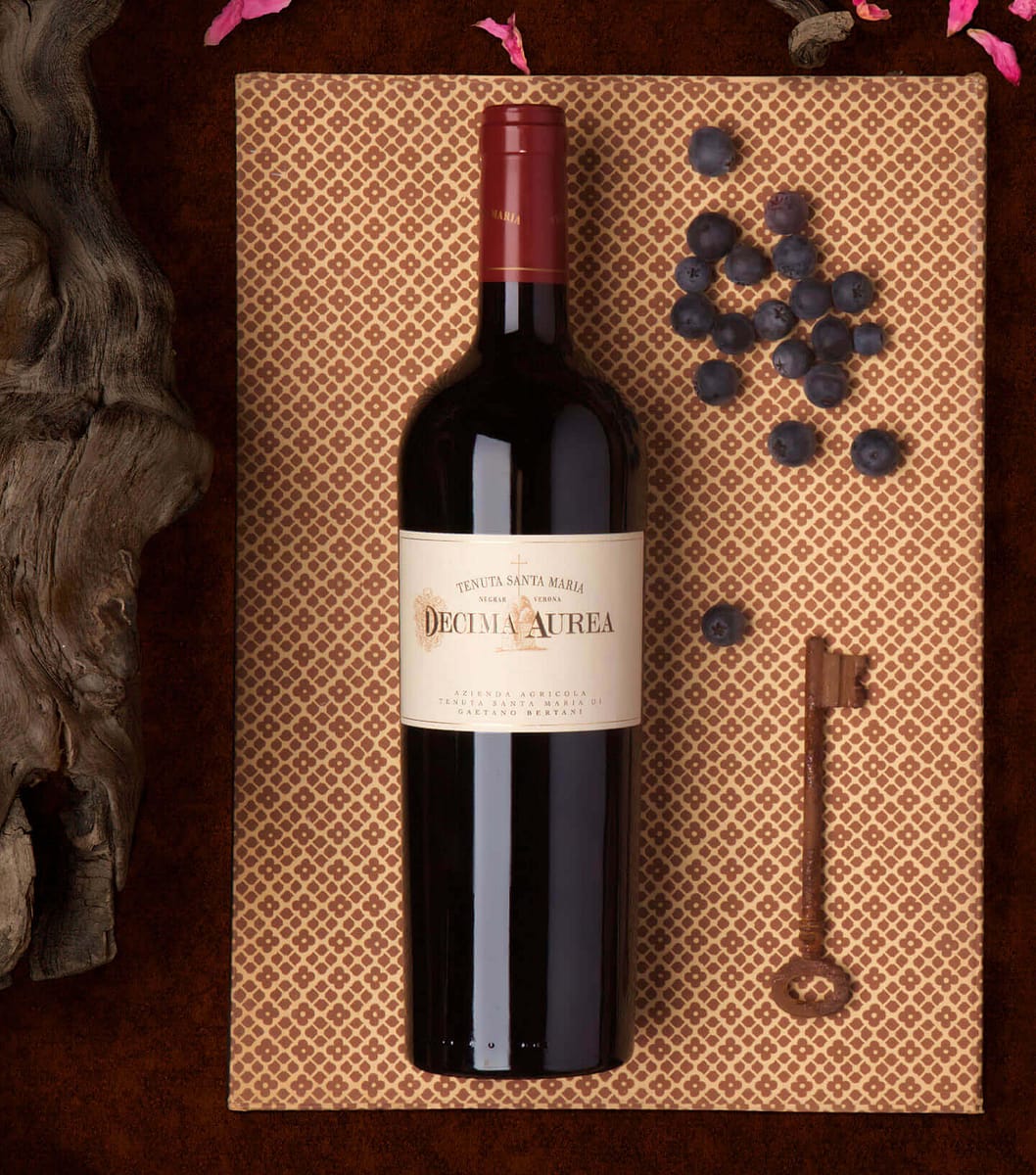
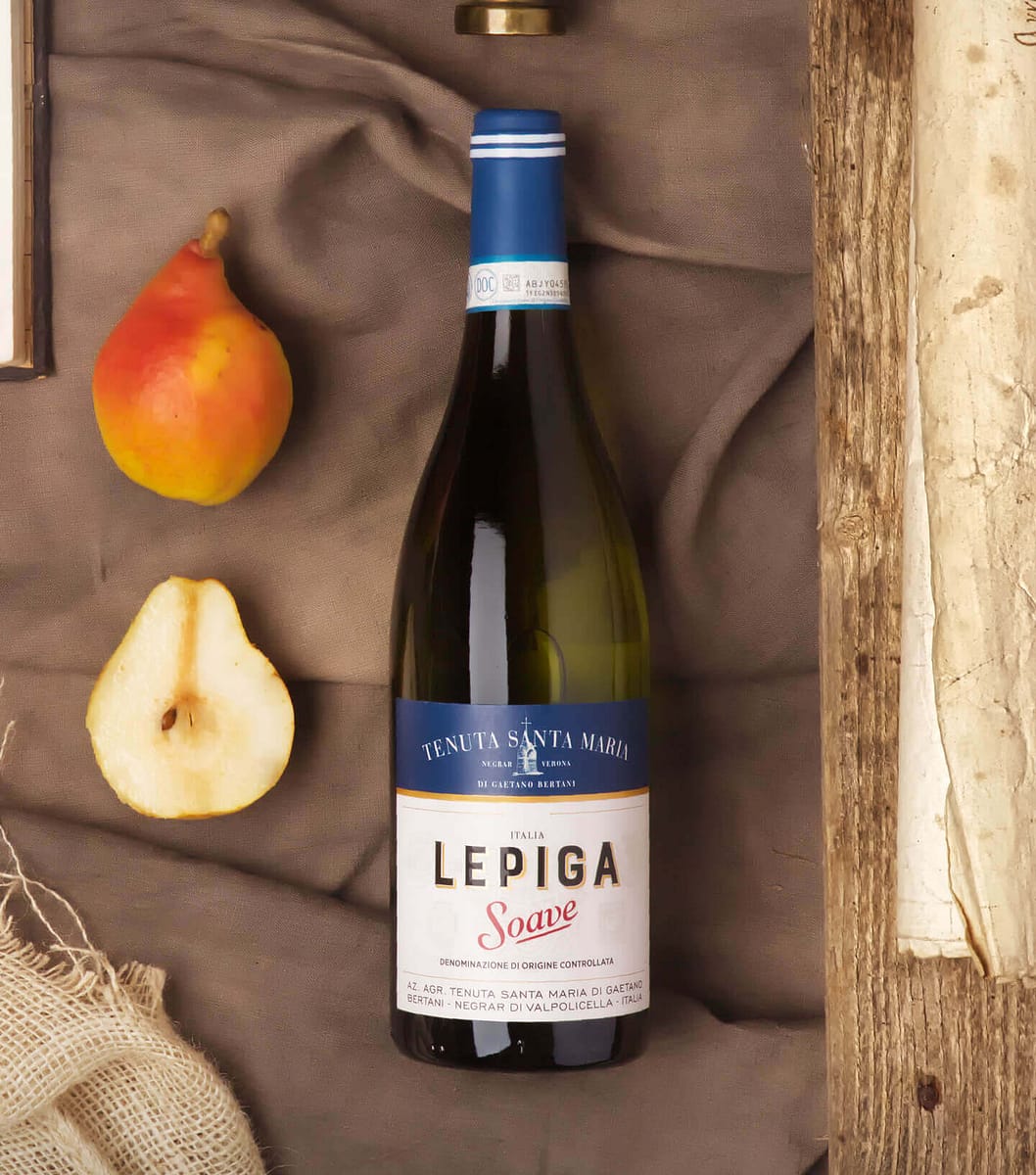
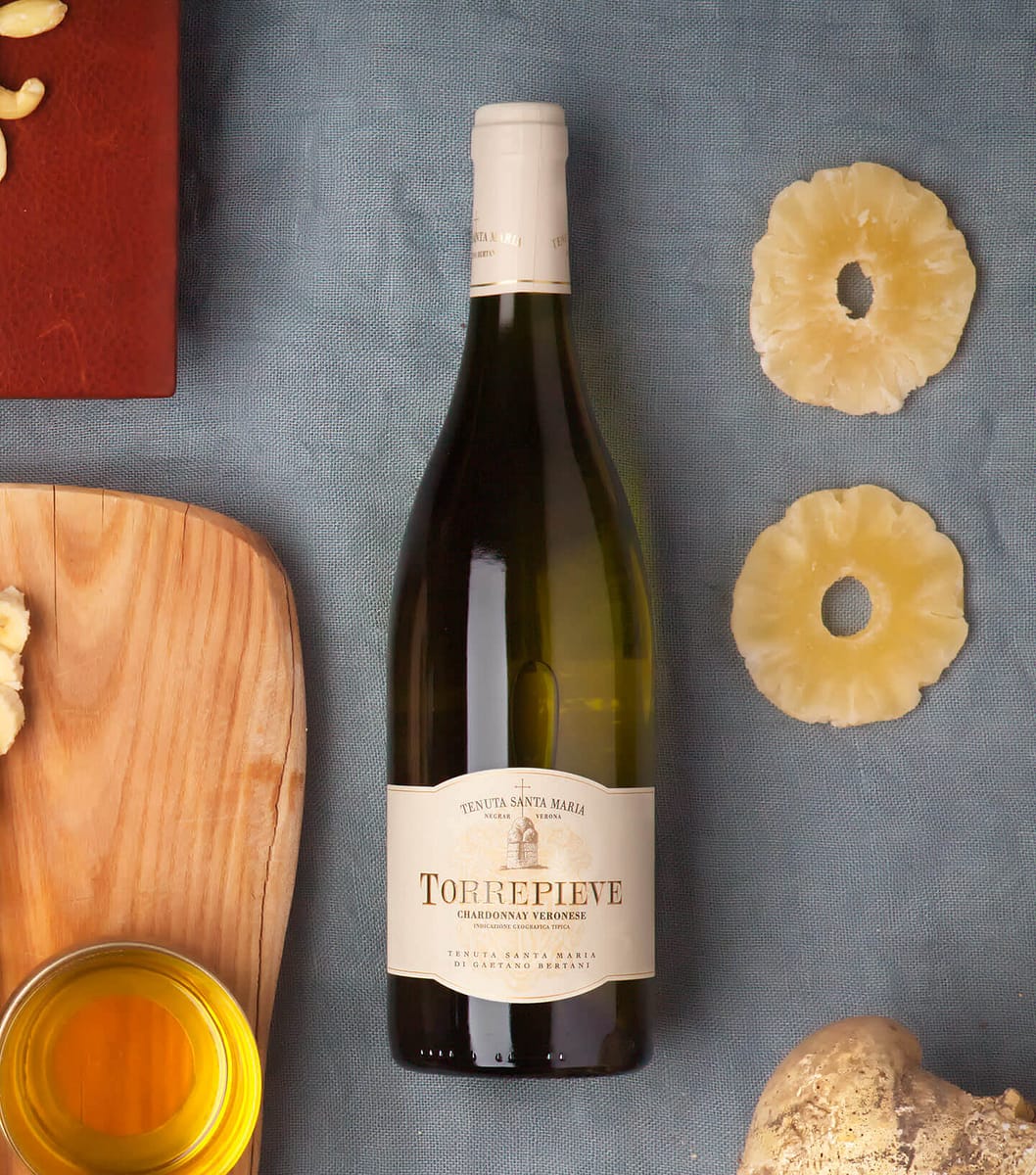
The Wines of Tenuta Santa Maria
Combining traditional methods, advanced technology, and experience passed down through generations of family tradition, we produce wines that are the full expression of our land.
Contain Sulfites