
The garden as thought
From Francis Bacon’s Of Gardens to Ippolito Pindemonte’s reflections on the English landscape garden, explore a vision of nature shaped with a gentle hand. At Tenuta Santa Maria, this philosophy comes to life through the park and the Venetian brolo, where beauty, cultivation and the Valpolicella landscape meet.
Pindemonte, Bacon and the idea behind our park
In 1792, before the Academy of Sciences, Letters and Arts in Padua, the Veronese poet Ippolito Pindemonte delivered an essay that would wait twenty-five years to reach its final printed form: it appeared in Verona in 1817, from the Mainardi press, as an appendix to his Prose e poesie campestri. The title, little read today outside literary circles, already says everything: a dissertation on English gardens, and on Italy’s own claim to that same sensibility.
It is no accident that these pages were written, and printed, here — between Verona and Valpolicella, a landscape Pindemonte knew intimately and where he spent long periods of his life. His was not a treatise on gardening technique, but a meditation on the relationship between nature and artifice, between geometric order and the freedom of landscape. Pindemonte saw the English garden — irregular, undulating, built to appear unbuilt — as a place where nature is gently guided rather than commanded, where the visitor is invited to lose themselves in thought, not simply to walk between hedges cut with a compass.
A Thought That Travels Further Back: Francis Bacon
Two centuries before Pindemonte, another mind had already laid the philosophical foundations of this same idea. Francis Bacon, the English thinker who, more than any other, taught the modern age to observe nature rather than impose an abstract order upon it, devoted one of his most intimate reflections to the garden: the celebrated essay Of Gardens, published in 1625.
Bacon opens his essay with a line that is at once theological and aesthetic: “God Almighty first planted a garden” — it was God himself, he writes, who planted the very first garden, making the cultivation of the earth a gesture that precedes every other human art, architecture included.
It is an idea that echoes with striking consistency in Pindemonte’s own thought: for Bacon, as for the Veronese poet, the garden is not an accessory of civilised living but its highest expression — higher, even, than building, because it demands a wisdom that works alongside nature rather than replacing it. Bacon himself observed, almost with regret, that men learn to build with elegance before they learn to cultivate with the same refinement, as though gardening were the harder perfection to attain.
In his essay, Bacon imagines an ideal garden that knows no dead season: for every month of the year he prescribes flowers, evergreen shrubs and different essences, so that something is always in bloom, always waiting to be discovered. It is a principle of natural succession rather than a fixed tableau — the very same logic that shapes a park designed to be walked through at different moments of the year, and one that stands just as firmly against the fashion for overly elaborate topiary: Bacon confessed a certain impatience with hedges cut into the shapes of animals and figures, calling them an amusement better suited to children than to the true art of the garden.
A direct thread runs between Bacon and Pindemonte, even across a century and a half: both reject the garden as a display of geometric control and imagine it instead as a place of patient observation, of seasons unfolding one into the next, of nature gently guided rather than dominated. It is no surprise that this same empirical, naturalistic philosophy, born in England with Bacon, later flowed — a century on — into the English landscape garden that Pindemonte would defend, and that Italy, in his view, never needed to import as a novelty, having practised something of the same spirit all along.
An idea that was never merely theory here
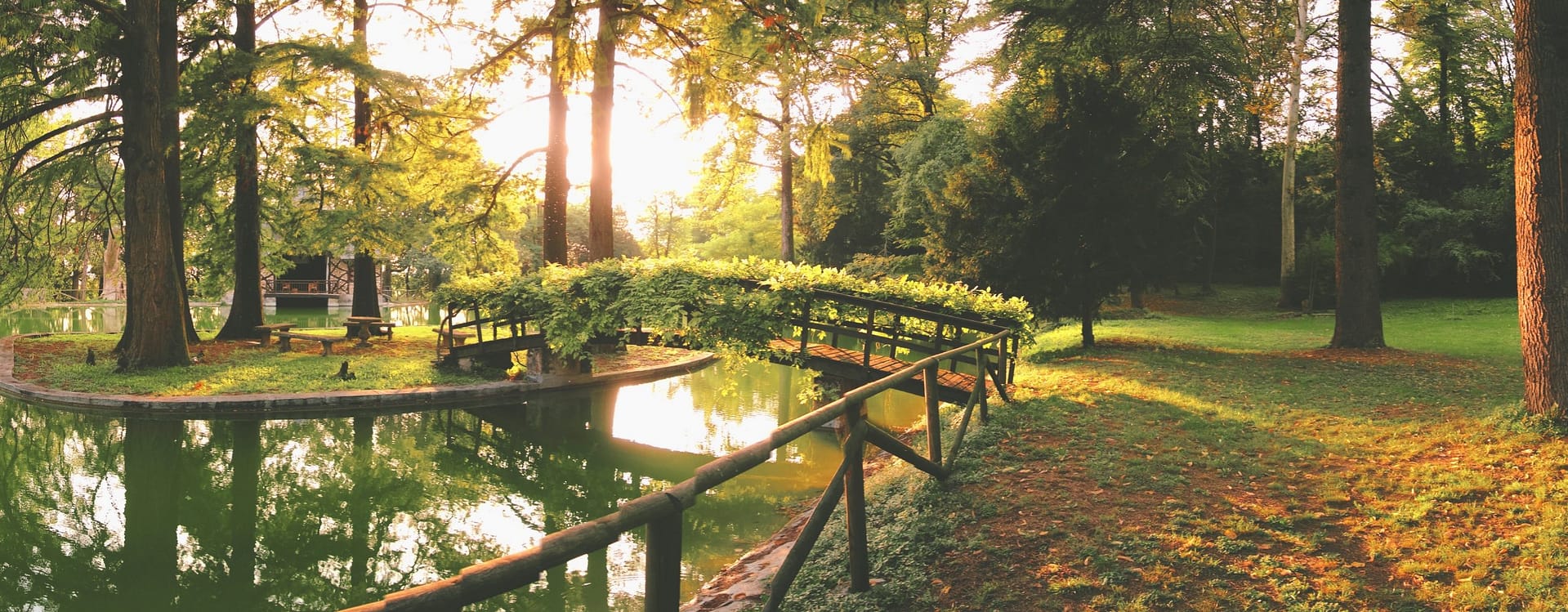
Walking through our park, that idea stops being literature and becomes physical experience. The paths do not run in straight lines: they follow the logic of the land, opening unexpected views, letting centuries-old trees, clearings and small architectural moments reveal themselves gradually, like a story that withholds its full meaning until the very end. This is precisely the principle Pindemonte defended against the more rigid, symmetrical Italian gardens of his time — and that Bacon had already anticipated: a beauty that arises from letting nature lead, guided only by a light hand.
Beside the park, and in natural continuity with it, lies the brolo — the oldest and most distinctly Venetian expression of this same philosophy. A brolo is neither a purely ornamental garden nor a simple orchard: it is an enclosed, cultivated space where fruit trees, vines and greenery intertwine without any strict hierarchy between the useful and the beautiful. In many ways, it is the local archetype of exactly what Pindemonte sought to reclaim for Italy — proof that our own tradition never needed to look to London alone to find a wise, non-dominating relationship with nature. The Venetian brolo, in its quiet way, had already anticipated that lesson — perhaps the oldest and quietest Italian answer to the very question Bacon was already asking in the seventeenth century.
Italy’s Own Claim
This is where Pindemonte’s dissertation becomes especially meaningful to those of us who live, every day, among vines and gardens. Italy’s “claim” in the title was never a matter of provincial pride, but an invitation to recognise that the Italian landscape — hilled, terraced, dotted with brogli and vineyards that follow the natural curves of the soil — already possessed its own unplanned irregularity, a beauty that was never drawn on a drafting table. For Pindemonte, the English garden was not a foreign model to imitate blindly, but a mirror reflecting back to Italy something it had, quite simply, stopped noticing in itself.
To walk our park today, and then descend toward the brolo, is to cross — almost without realising it — four centuries of this same idea: from Bacon’s natural philosophy, which saw in the garden the purest of human pleasures, to the more explicit echo of the romantic garden Pindemonte theorised, and finally to the rural, Venetian form that same sensibility had always quietly preserved, long before anyone felt the need to put it into words.
An invitation, for those who visit us: the park first, then the brolo. And perhaps, somewhere between the two, a passing thought for the men — in London as in Verona — who knew how to write down what these places still tell us today, in silence.
Ippolito Pindemonte was born in Verona and spent long periods in Valpolicella, a landscape he knew intimately; his dissertation on English gardens was, moreover, printed in Verona in 1817, making this territory a natural point of reference for anyone seeking the Italian roots of the romantic garden.
The park and the brolo are located within our estate in the Valpolicella Classica, just steps from the villa and the cellars — two complementary spaces that can be explored as part of our hospitality and wine-tourism experiences.
A brolo is an enclosed, cultivated space typical of Venetian rural tradition, where fruit trees, vines and greenery coexist without a strict separation between utility and beauty — a garden-orchard concept that, in substance, predates nineteenth-century romantic taste.
An Italian garden follows geometric lines, symmetry and ordered perspectives; an English garden, by contrast, imitates the natural flow of the landscape, with irregular paths, clearings and views that reveal themselves gradually to the visitor.
The English philosopher and scientist Francis Bacon published his essay Of Gardens in 1625, laying the philosophical groundwork for a garden understood as patient observation of nature rather than an exercise in geometry — a way of thinking that would go on to shape the birth of the English landscape garden a century later.
It is an essay by the Veronese poet Ippolito Pindemonte, first read in 1792 and published in its final form in Verona in 1817, reflecting on the aesthetic and cultural value of the English landscape garden and on Italy’s own claim to that same sensibility.